Opting for health insurance in India can seem confusing, especially when you come across coverage options like Rs 5 lakh, Rs 10 lakh and Rs 20 lakh.
A common question is:
“How much health insurance coverage do I actually need?”
There is no single sum insured that is suitable for every individual or family. Your age, family size, location, medical history, lifestyle, existing health conditions, expected healthcare needs and budget will all play a part in determining the right level of coverage.
In some cases, ₹5 lakh may appear to be sufficient for a healthy individual. A family in a big city might consider ₹10 lakh or more to provide a more comfortable financial cushion. For senior citizens, families with existing medical concerns or households that want stronger protection against major hospitalisation expenses, a ₹20 lakh cover or a combination of a base policy and top-up health insurance in India might be worth considering.
IRDAI states that health insurance premiums are determined by various factors, including age and other relevant risk factors. Premium rates for family floater plans also depend on the number of members covered under the policy.
This guide will assist you to compare coverage of ₹5 lakh, ₹10 lakh and ₹20 lakh and choose a level that suits your circumstances.
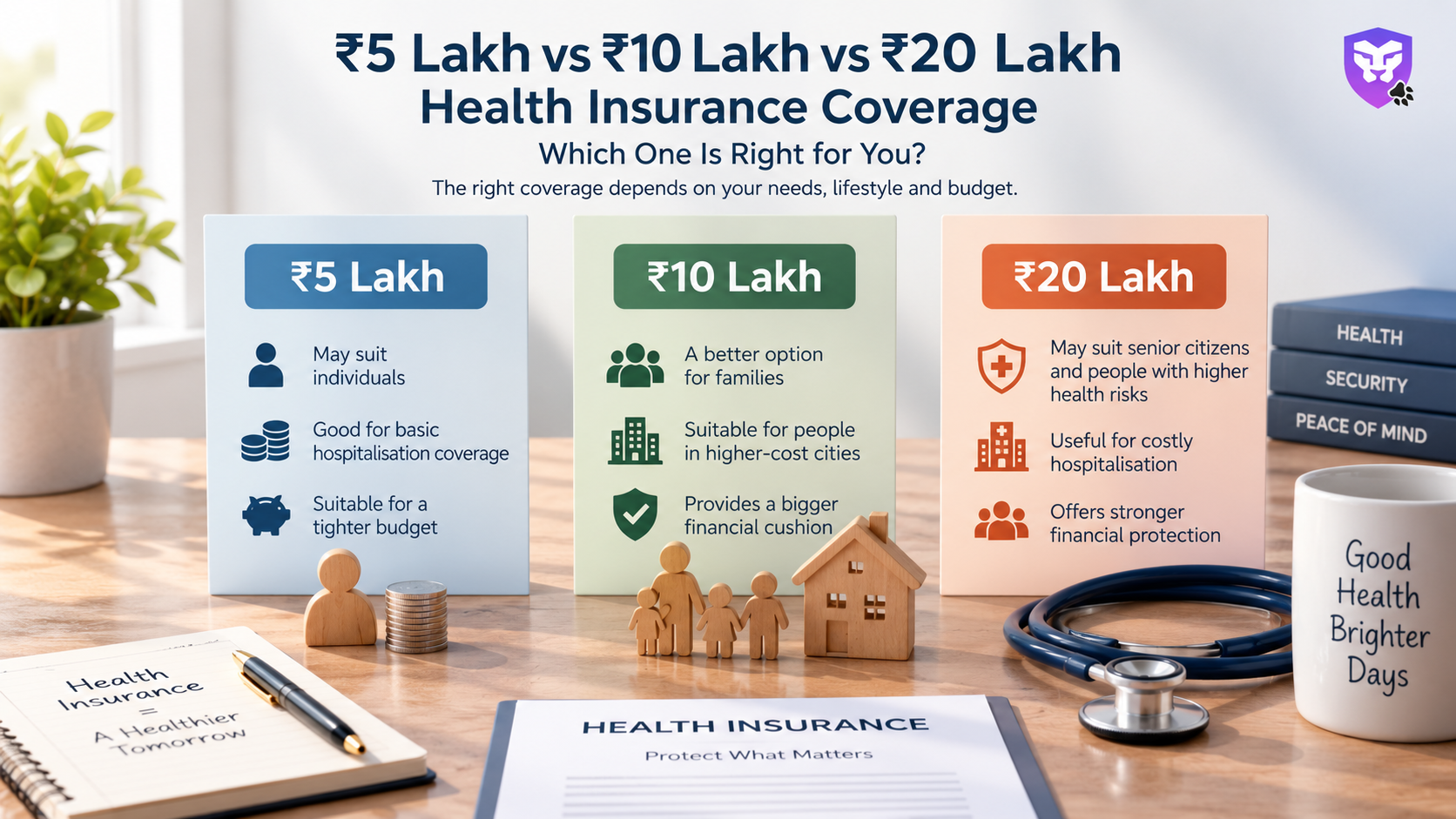
Quick Answer: Is ₹5 Lakh, ₹10 Lakh or ₹20 Lakh Health Insurance Better?
A ₹5 lakh health insurance plan could be a good option for individuals who are relatively healthy or seeking basic hospitalisation coverage on a tight budget.
A health insurance of ₹10 lakh can be a bigger financial cushion and suitable for families, people living in higher-cost cities or people who want wider protection.
Families, older adults, people with higher health risk exposure or people looking for stronger protection against costly hospitalisation may consider a ₹20 lakh health insurance providing a significantly higher sum assured.
However, a higher sum insured does not automatically mean a better health insurance policy.
When comparing the best health insurance plans in India, you should also look into the waiting period, exclusions, co-payments, deductibles, room-rent restrictions, network hospitals, restoration benefits, claim conditions and if the coverage matches your actual needs.
Also, IRDAI asks insurers to offer health insurance options that suit different ages and health needs, but specific coverage may vary depending on the product and the add-ons or riders that apply.
What Does “₹5 Lakh Health Insurance” Actually Mean?
The ₹5 lakh figure refers to the policy's sum insured, subject to its terms and conditions.
It does not necessarily mean that the insurer will automatically pay ₹5 lakh for every medical event.
The actual claim settlement can depend on:
- Covered treatment
- Policy terms and conditions
- Waiting periods
- Exclusions
- Deductibles
- Co-payments
- Sub-limits
- Eligible medical expenses
- Available sum insured
IRDAI defines a deductible as an amount the policyholder bears before the insurer's liability begins under applicable indemnity policies, while a sub-limit is a predefined limit for specified treatments, services, conditions or situations.
This is why simply comparing the ₹5 lakh, ₹10 lakh or ₹20 lakh number is not enough.
₹5 Lakh Health Insurance: Who May Consider It?
You could take a policy of ₹5 lakh as a basic layer of health cover, especially if you are relatively healthy and don’t have a lot of money to spend.
It may be useful for:
- Young people
- New policy buyers
- People who want basic hospital coverage
- People who have an emergency fund in place
- Buyers who intend to add coverage with a top-up or super top-up
The downside is that serious medical treatment can be costly, and major hospitalisation can deplete the sum insured more quickly.
So, just because ₹5 lakh is affordable, it should not be considered “enough”.
When ₹5 Lakh May Feel Limited
The coverage may become less comfortable when:
- You live in a city with expensive private healthcare
- More than one family member is covered
- You have older parents
- A serious illness requires prolonged treatment
- You need advanced procedures or specialist care
- Multiple claims occur during the policy year
Before selecting a lower sum insured, consider whether you could comfortably pay a large amount above the available coverage from your savings.
₹10 Lakh Health Insurance: A More Balanced Option?
For many buyers, ₹10 lakh can be a middle ground between affordability and a bigger financial cushion.
It may be considered for:
- Additional protection for individual policyholders
- Young couples
- Small family (2)
- Parents with moderate medical needs
- People who live in higher-cost metro areas
Buyers looking for higher coverage without going for ₹20 lakh straightaway
In the case of people looking for family health insurance in India, the structure of the policy is as important as the amount.
A ₹10 lakh family floater divides the total sum insured among covered family members. So a big claim by one member might reduce the pool available to others during the policy period.
Thus, families should consider the number of family members and their ages before deciding on the sum assured.
₹20 Lakh Health Insurance: When Does It Make Sense?
A health insurance policy of ₹20 lakh provides substantially higher coverage and may offer better protection against large hospitalisation costs.
When could it be worth considering?
- Coverage for several family members
- You live in an expensive city.
- You want better protection from high medical bills
- You have elder family members
- You are more exposed to health risks
- You need more protection against serious illnesses
- You like a larger base policy rather than relying on top-up coverage
In case the medical costs are high or you have to avail multiple treatments covered under the policy in the same year, a higher sum insured can be especially useful.
But affordability is still important. The best policy is one that you can continue on a continuous basis and not one that becomes difficult to renew because the premium is too high.
₹5 Lakh vs ₹10 Lakh vs ₹20 Lakh: Simple Comparison
| Factor | ₹5 Lakh | ₹10 Lakh | ₹20 Lakh |
|---|---|---|---|
| Coverage level | Basic | Moderate | Higher |
| Budget requirement | Lower | Moderate | Higher |
| Suitable for | Basic individual protection | Individuals and small families | Families and higher-risk needs |
| Financial cushion | Limited | Better | Stronger |
| Major hospitalisation protection | More limited | More comfortable | Higher protection |
| Suitable for family floater | Possible, but assess carefully. | Often considered for small families | Can provide stronger shared coverage |
| Need for top-up | Maybe useful | Maybe useful | May be less urgent, depending on needs |
| Best for | Budget-focused buyers | Balanced protection | Higher coverage preference |
This table is only a general guide. The right coverage depends on your circumstances and the specific policy terms.
How Much Health Insurance Do You Need as an Individual?
For individual health insurance in India, consider:
Your Age
Health insurance premiums can vary with age, and healthcare requirements can change over time. IRDAI states that age is a key factor in health insurance pricing.
Confused between health insurance plans?
Let AI decide for you.
- AI compares 30+ insurers
- No sales pressure
- Result in 60 seconds
- 100% free
No spam. No calls unless you want them.
A younger buyer may have different coverage requirements from someone approaching retirement.
Your City
Healthcare expenses can vary significantly depending on the hospital, treatment, specialist and city.
If you primarily use private hospitals in a major metropolitan area, a larger sum insured may provide more comfort.
Your Medical History
To determine your coverage needs, consider your existing conditions, prior treatments and family medical history.
IRDAI defines pre-existing disease within its health insurance framework, so buyers should accurately disclose relevant medical information when applying for a policy.
Your Savings
Ask yourself:
“If my medical bill exceeds my insurance coverage, how much could I comfortably pay from my savings?”
Your financial buffer should influence the level of health insurance you choose.
How Much Coverage Does a Family Need?
In India, family health insurance is typically a family floater policy, wherein the sum insured is shared between all the members.
When choosing coverage for a family, think about:
Number of family members:
- Parents’ Age
- Child’s age
- Medical history
- Place of residence
- Preferences for the Hospitals
- Household budget
- Current employer coverage
- Expected health needs
A family with two young adults and one child has a different risk profile than a family covering two adults, two children and senior parents.
So, do not opt for a family floater just because its premium looks cheaper.
Should Senior Citizens Get More Health Insurance Coverage?
Senior citizen health insurance in India needs to be considered carefully, as healthcare needs can get complicated with growing age.
Senior citizens may need to examine:
- Sum insured
- Co-payment requirements
- Waiting periods
- Pre-existing disease coverage
- Room-rent limits
- Day-care coverage
- Network hospital availability
- Renewal terms
- Claim conditions
IRDAI states that health insurance policies are ordinarily expected to provide coverage from entry age up to at least 65 years, while some products offer coverage beyond that age. It also states that once a policy is issued and renewed without a break, renewal cannot be denied on age grounds for applicable health policies.
The exact availability, eligibility and features depend on the insurer and policy.
What About Health Insurance for Parents?
When purchasing health insurance for parents in India, do not evaluate the policy based solely on the premium.
Parents may have higher healthcare requirements, so examine the policy structure carefully.
Look at:
- Coverage for pre-existing diseases
- Waiting periods
- Co-payment
- Network hospitals
- Room-rent limits
- Day-care procedures
- Restoration benefits
- Renewal conditions
- Claim process
A cheaper policy may not necessarily provide better practical protection if significant restrictions apply.
What About Health Insurance for Women?
Health insurance for women in India should be selected based on individual healthcare needs rather than gender alone.
Depending on the policy, buyers may consider coverage features related to:
- Hospitalisation
- Maternity
- Newborn care
- Women-specific illnesses
- Preventive care where offered
- Day-care procedures
- Critical illness coverage
When looking specifically for maternity health insurance in India, pay close attention to the maternity waiting period, coverage limits, eligible expenses and newborn-related benefits.
Do not assume that every standard health insurance policy automatically includes maternity coverage.
Health Insurance for Children in India
For health insurance for children in India, parents should evaluate:
- Hospitalisation coverage
- Day-care procedures
- Network hospitals
- Room-rent conditions where applicable
- Waiting periods
- Newborn provisions if relevant
- Family floater structure
A family floater may cover children along with parents, but parents should understand how the shared sum insured works.
Do You Need Critical Illness Insurance?
Critical illness insurance in India works differently from standard hospitalisation insurance.
A critical illness policy may provide a fixed benefit when the insured is diagnosed with a covered critical illness, subject to the policy's definitions and terms.
It should therefore not automatically be considered a replacement for comprehensive hospitalisation insurance.
Similarly, cancer insurance in India may provide specialised financial protection for covered cancer-related conditions depending on the policy design.
The most suitable combination depends on your broader financial and health protection strategy.
What About Accident Insurance?
Accident insurance in India can address risks associated with accidental injury, disability or accidental death, depending on the policy.
Accident insurance and health insurance serve different purposes.
A standard health insurance policy generally focuses on covered medical and hospitalisation expenses, while personal accident insurance may provide specified benefits arising from accidental events.
Some individuals may choose to maintain both types of protection.
Is Cashless Health Insurance Better?
Confused between health insurance plans?
Let AI decide for you.
- AI compares 30+ insurers
- No sales pressure
- Result in 60 seconds
- 100% free
No spam. No calls unless you want them.
Cashless health insurance in India generally refers to treatment at eligible network hospitals where covered expenses can be settled directly between the insurer and hospital, subject to applicable policy terms and authorisation procedures.
Before buying a policy, check:
- Number and quality of network hospitals
- Hospitals available near your home
- Hospitals near your parents
- Whether your preferred hospital is included
- Cashless claim procedures
- Pre-authorisation requirements
A large network is useful only if it includes hospitals that are practical for you.
Should You Use a Health Insurance Premium Calculator?
A health insurance premium calculator in India can help estimate premiums based on factors such as age, number of members, coverage amount and other details.
Use a calculator as a starting point rather than the sole basis for choosing a policy.
A lower premium is not necessarily better if the policy has conditions or restrictions that do not suit your needs.
When you compare health insurance plans in India, compare both price and coverage.
What Is Top-Up Health Insurance?
Top-up health insurance in India can provide additional coverage above a specified deductible.
This can be useful for policyholders who want a higher overall protection level without paying the full premium for a huge base policy.
For example, someone might combine a base health policy with additional top-up or super top-up protection, depending on the product terms.
However, top-up and super top-up products work differently, so buyers should understand the deductible and claim structure before purchasing.
Is Health Insurance Without Medical Tests Available in India?
Some health insurance products or purchase situations may be available without a pre-policy medical examination, but this depends on the insurer, applicant profile, age, product design and underwriting rules.
Therefore, the phrase “Health Insurance Without Medical Test in India” should not be interpreted as meaning that every buyer can obtain any policy without medical evaluation.
Insurers may still ask health-related questions, medical declarations or other information during underwriting.
Always disclose your medical history honestly. Incorrect or incomplete disclosure can create problems during claims.
What Should You Check Before Buying Health Insurance?
Before you buy health insurance online in India, do not focus only on the premium or sum insured.
Check these key features:
1. Sum Insured
Choose an amount that realistically matches your financial risk.
2. Waiting Period
Check the waiting period for specific treatments and pre-existing diseases.
3. Room-Rent Restrictions
Find out whether the policy places limits on the room category or related expenses.
4. Co-Payment
A co-payment means you may have to bear a specified portion of eligible expenses.
5. Deductibles
Understand whether the policy includes a deductible and how it affects claims.
6. Sub-Limits
Check whether certain treatments or services have predefined limits.
7. Network Hospitals
Confirm that hospitals you are likely to use are part of the insurer's network.
8. Restoration or Reinstatement Benefits
Understand whether and how the sum insured can be restored after an eligible claim.
9. No-Claim Bonus
Check whether the policy provides an increase in the sum insured or any other benefit for claim-free years.
10. Exclusions
Read what the policy does not cover instead of focusing only on advertised benefits.
What Is Top-Up Health Insurance?”
How to Choose the Right Coverage: A Practical Framework
Instead of asking only:
“Should I buy ₹5 lakh, ₹10 lakh or ₹20 lakh?”
ask these five questions:
Question 1: Who Are You Covering?
An individual, couple, children and senior parents can require different coverage strategies.
Question 2: Where Do You Live?
Consider the cost of private healthcare and the hospitals you are likely to use.
Question 3: What Is Your Health Risk?
Age, medical history and family circumstances should influence your decision.
Confused between health insurance plans?
Let AI decide for you.
- AI compares 30+ insurers
- No sales pressure
- Result in 60 seconds
- 100% free
No spam. No calls unless you want them.
Question 4: How Much Can You Afford?
Choose coverage that you can maintain over the long term.
Question 5: What Happens Above Your Base Coverage?
Consider whether a top-up or super top-up could provide additional financial protection.
A General Coverage Guide
This is a planning framework, not a universal recommendation:
₹5 Lakh
May be considered when:
- You are a young individual
- Your budget is limited
- You have additional savings
- You already have employer coverage
- You are planning to add top-up coverage
₹10 Lakh
May be considered when:
- You want a stronger financial buffer
- You are buying individual coverage
- You are a young couple or small family
- You want broader protection without moving immediately to ₹20 lakh
₹20 Lakh
May be considered when:
- Multiple people need coverage
- Senior citizens are involved
- You live in a higher-cost healthcare market
- You want stronger protection against major hospitalisation
- You have greater financial capacity for premium
Again, the actual recommendation should be based on your circumstances and the policy's features.
What Is the Best Health Insurance in India?
There is no single best health insurance in India for every person.
The best policy is the one that provides suitable coverage for your needs at a sustainable premium and offers policy terms you understand.
When comparing the best health insurance plans in India, evaluate:
- Coverage amount
- Network hospitals
- Waiting periods
- Exclusions
- Co-payment
- Deductibles
- Room-rent restrictions
- Claim procedures
- Renewal conditions
- Premium affordability
- Additional benefits
A policy should be judged by its complete structure rather than by the brand name or premium alone.
FAQs About ₹5 Lakh, ₹10 Lakh and ₹20 Lakh Health Insurance
Is ₹5 lakh health insurance enough in India?
It can provide basic financial protection, particularly for some young and relatively healthy individuals, but it may be insufficient for large hospitalisation expenses or families with higher healthcare needs.
Is ₹10 lakh health insurance enough for a family?
It can be a reasonable starting point for some small families, but the right amount depends on the ages of family members, city, health conditions, hospital costs and whether the policy is a family floater.
Is ₹20 lakh health insurance worth it?
A ₹20 lakh sum insured may provide a larger financial buffer against significant hospitalisation costs. It can be particularly relevant for families or people who want stronger protection, provided the premium is affordable and the policy conditions are suitable.
Should I buy ₹5 lakh or ₹10 lakh health insurance?
If your budget allows, ₹10 lakh can provide a larger coverage cushion than ₹5 lakh. However, it’s important to compare the full policy benefits and restrictions instead of choosing based solely on the sum insured.
Should I buy ₹10 lakh or ₹20 lakh health insurance?
Consider the number of people covered, age, health risks, healthcare costs in your city, savings and whether you can supplement the base policy with a top-up or super top-up.
Is family floater insurance better than individual health insurance?
Not universally. A family floater can be convenient for families because members share a common sum insured, while separate individual policies may be considered when members have significantly different ages or healthcare needs.
Can senior citizens buy health insurance in India?
Yes. Health insurance products are available for senior citizens, although eligibility, premiums, waiting periods and policy features vary. IRDAI states that health insurance policies are ordinarily expected to provide entry age of at least 65 years, with some products available beyond that age.
Does health insurance cover pre-existing diseases immediately?
Not necessarily. Applicable waiting periods and policy conditions may apply. Pre-existing disease definitions and coverage terms should be checked carefully before purchase.
Does health insurance cover maternity?
Only when maternity benefits are included under the relevant product or policy terms. Buyers should check the waiting period, limits, eligibility conditions and exclusions before purchasing maternity health insurance in India.
Is cashless health insurance available at every hospital?
No. Cashless treatment generally depends on the insurer's network arrangements and applicable authorisation procedures. Confirm your preferred hospitals before buying the policy.
Can I buy health insurance online?
Yes. Consumers can purchase health insurance online, but they should review the policy wording, benefits, exclusions, waiting periods, deductibles, co-payment and claim procedures before making a decision.
Final Thoughts
The choice between ₹5 lakh, ₹10 lakh and ₹20 lakh health insurance is not simply a question of choosing the highest number.
Your ideal coverage depends on your age, family structure, city, healthcare needs, medical history, existing insurance and financial capacity.
For some individuals, ₹5 lakh may be a starting point. For others, ₹10 lakh may offer a more comfortable balance. Families, older adults and people seeking stronger protection may consider ₹20 lakh or a base policy combined with top-up health insurance in India.
The most important step is to look beyond the headline sum insured.
Before choosing one of the best health insurance plans in India, compare the policy's coverage, exclusions, waiting periods, network hospitals, deductibles, co-payments, claim conditions and long-term affordability.
The right health insurance is not necessarily the cheapest policy or the policy with the highest coverage. It is the policy that gives you appropriate financial protection when you actually need it.

Written By
Raj Shankar
Principal Officer and General Manager at CoverTiger
With over 7 years of experience in the insurance and fintech industry, Raj Shankar has helped 10,000+ customers secure their families with the right insurance solutions. He has worked with leading brands such as Policybazaar, INDmoney, and CoverTiger, building strong expertise in health insurance, life insurance, sales leadership, and customer advisory. His mission is to make insurance simpler, more transparent, and accessible for every Indian family.