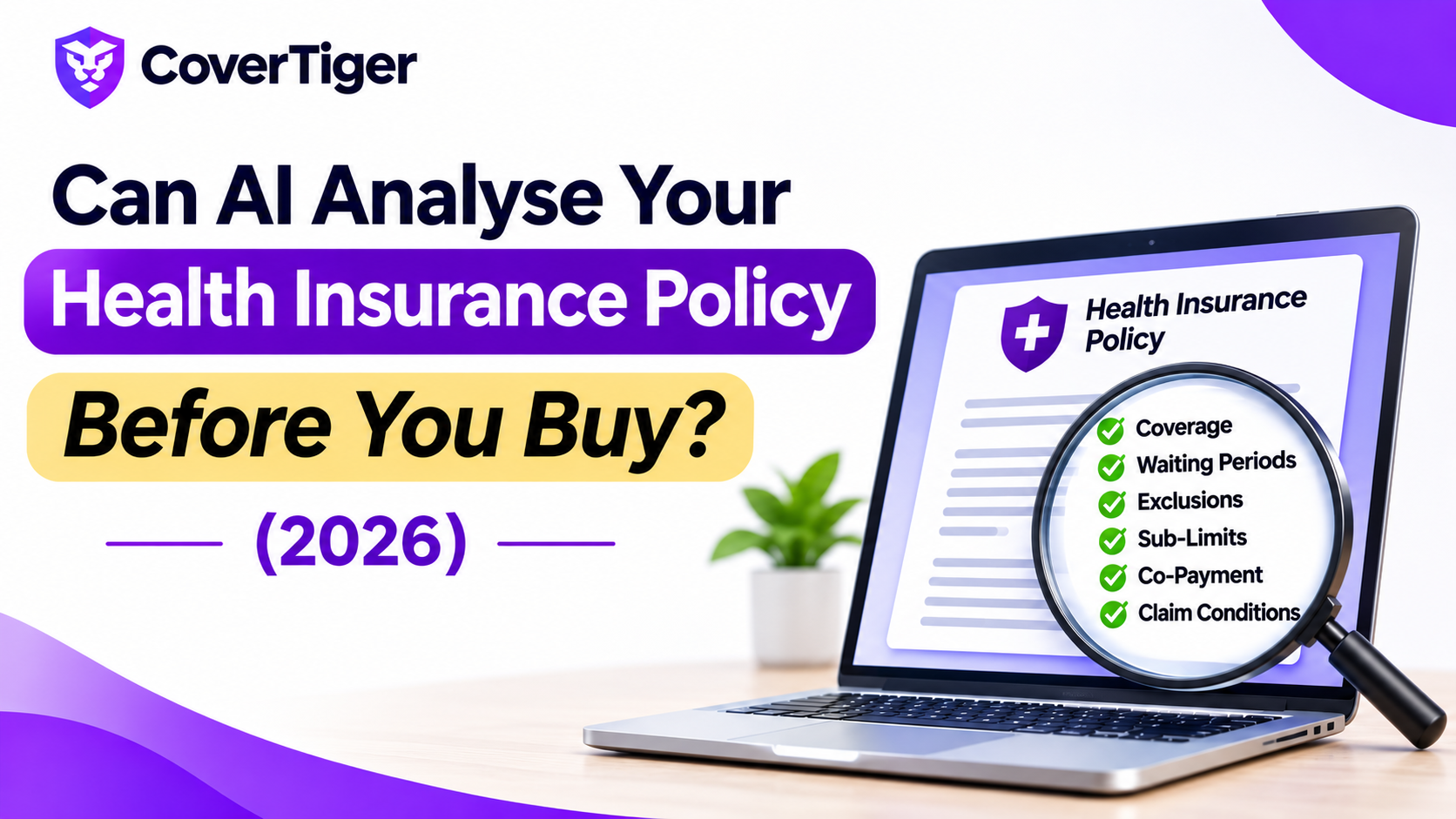
Can AI Analyse Your Health Insurance Policy Before You Buy? (2026)
Buying health insurance is not just about selecting a premium and sum insured. A policy may include waiting periods, exclusions, room-rent limits, co-payments, deductibles and other conditions that can affect how much the insurer pays during a claim.
Many customers purchase a policy after reading a short brochure or comparing a few benefits. However, the actual policy document contains important details that deserve attention before making a decision.
This is where an AI Insurance Policy Analyzer can help.
Artificial intelligence can assist customers in reviewing policy documents, understanding complex insurance terminology and identifying important conditions that deserve a closer look. It can make health insurance research easier, especially for people comparing multiple plans.
In this guide, we explain how AI can analyse a health insurance policy, which details you should review before buying and how an AI Insurance Advisor like CoverTiger's Ira can support your research.
What Is an AI Insurance Policy Analyzer?
An AI Insurance Policy Analyzer is a digital tool that uses artificial intelligence to read and interpret information from insurance documents.
Depending on the tool's capabilities, users may be able to upload a policy brochure, Customer Information Sheet (CIS) or policy wording document and ask questions about its contents.
For example, an AI tool may help explain:
- What medical expenses are covered?
- Which treatments have waiting periods?
- Are there any room-rent or disease-wise sub-limits?
- Does the policy include a co-payment?
- Which exclusions should I understand?
- What conditions apply to cashless and reimbursement claims?
- Are there any important renewal or portability conditions?
Instead of reading a lengthy document without guidance, customers can use AI to locate relevant sections and understand them in simpler language.
However, AI analysis is only a support tool. It should not be treated as an official interpretation from the insurer or a guarantee that a future claim will be approved.
Why Should You Analyse Your Health Insurance Policy Before Buying?
Two health insurance plans may offer the same sum insured but have different terms and conditions.
For example, one plan may have a particular room category limit, while another may offer different room eligibility. One policy may have a co-payment for certain insured members, while another may not. Waiting periods and exclusions can also vary.
Looking only at the premium or headline benefits may therefore lead to an incomplete comparison.
Before purchasing a policy, review these areas:
- Coverage: Which hospitalisation and medical expenses are included?
- Exclusions: Which treatments, expenses or circumstances are not covered?
- Waiting periods: When does coverage become available for specified conditions?
- Sub-limits: Are there maximum payable amounts for particular expenses?
- Co-payment: Will you have to pay a percentage of an admissible claim?
- Deductibles: Is there an amount you must pay before the insurer contributes?
- Claim procedure: What documents and steps are required?
- Renewal conditions: What happens when the policy comes up for renewal?
An AI Insurance Advisor can help organise these details into a checklist before you make a purchase decision.
How Can AI Analyse a Health Insurance Policy?
An AI-based policy review can be useful when it focuses on specific policy clauses rather than simply summarising the entire document.
1. Review Policy Coverage
The first step is to understand what the policy actually covers.
Depending on the product, health insurance may include benefits such as:
- In-patient hospitalisation
- Day-care procedures
- Pre-hospitalisation expenses
- Post-hospitalisation expenses
- Ambulance expenses
- Modern treatments
- Organ donor expenses
- Home healthcare or domiciliary treatment, where applicable
An AI tool can help locate these benefits in the policy document and explain the associated conditions.
For example, you could ask:
"Does this policy cover pre-hospitalisation and post-hospitalisation expenses? Please identify the relevant conditions and limits."
The tool can then help you find the relevant sections. You should verify the answer against the original policy wording.
2. Identify Policy Exclusions
Exclusions explain which treatments, expenses or situations are not covered under a policy.
These are among the most important sections to review before purchasing health insurance.
An AI Insurance Policy Analyzer may help identify and organise exclusions into categories, such as:
Confused between health insurance plans?
Let AI decide for you.
- AI compares 30+ insurers
- No sales pressure
- Result in 60 seconds
- 100% free
No spam. No calls unless you want them.
- General exclusions
- Specific treatment-related exclusions
- Non-medical expenses
- Waiting-period-related restrictions
- Conditions linked to medical history
- Other product-specific exclusions
It can also explain unfamiliar terms in simple language.
For example, if a policy contains a clause about a particular treatment, you can ask AI to explain what the clause means and what questions you should ask the insurer.
Do not assume that a treatment is covered or excluded based only on an AI summary. Read the complete clause and confirm any uncertainty with the insurer.
3. Check Waiting Periods
Waiting periods determine when certain benefits become available under a health insurance policy.
Common categories include:
- Initial waiting period
- Pre-existing disease waiting period
- Specified disease or procedure waiting period
- Other product-specific waiting periods
The applicable period depends on the policy and its conditions.
An AI tool can help locate waiting-period clauses and organise them in a simple table.
| Waiting-period category | What to check |
|---|---|
| Initial waiting period | Whether an initial waiting period applies after policy commencement |
| Pre-existing diseases | The applicable period and how pre-existing conditions are defined |
| Specified diseases | Which diseases or procedures have a separate waiting period |
| Other conditions | Any additional product-specific restrictions |
This can help customers understand which benefits may not be immediately available after purchasing a policy.
4. Find Sub-Limits and Room-Rent Restrictions
A policy may provide a large sum insured while applying specific limits to certain expenses.
For example, a policy may have conditions relating to:
- Room category eligibility
- ICU charges
- Specific medical procedures
- Ambulance expenses
- Particular treatments
These limits can influence the amount payable during a claim.
AI can help locate these clauses and explain them using examples. If a policy has a room eligibility restriction, you can ask the tool to explain how choosing a higher room category may affect claim settlement under the applicable terms.
The exact financial impact depends on the policy wording and claim circumstances. Do not rely on a generic example as a calculation of your own claim.
5. Understand Co-Payments and Deductibles
Co-payment and deductible are two terms that customers should understand before buying health insurance.
Co-payment: A specified percentage of an admissible claim that the insured person must pay, as per the policy.
Deductible: A specified amount that must be paid by the insured person before the insurer's payment obligation applies, according to the policy.
AI can help identify whether these conditions apply and explain their possible financial impact.
For example, you can ask:
"Does this policy have a co-payment or deductible? If yes, explain when it applies and how it may affect a claim."
Always check whether the condition applies to all claims, particular treatments, specific age groups or selected policy variants.
6. Review Claim Conditions and Documents
A policy may contain important requirements about how and when claims must be reported, what documents are needed and how cashless or reimbursement claims are handled.
An AI tool can help you locate:
- Cashless claim procedure
- Reimbursement claim procedure
- Hospitalisation notification requirements
- Required medical documents
- Pre-authorisation conditions
- Claim submission timelines
- Insurer and grievance contact details
It can turn these clauses into a simple checklist.
However, the insurer's official claim instructions and the applicable policy terms remain authoritative.
Confused between health insurance plans?
Let AI decide for you.
- AI compares 30+ insurers
- No sales pressure
- Result in 60 seconds
- 100% free
No spam. No calls unless you want them.
Which Documents Should You Upload for AI Policy Analysis?
For a more useful review, provide the correct and complete documents.
| Document | Why it matters |
|---|---|
| Policy wording | Contains detailed terms, conditions and exclusions |
| Customer Information Sheet (CIS) | Summarises important policy features in simple language |
| Product brochure | Provides an overview of benefits and product features |
| Premium quotation | Helps review the quoted premium and selected options |
| Add-on or rider details | Explains additional benefits and their conditions |
The Customer Information Sheet is particularly useful because it brings important details together, including coverage, exclusions, sub-limits, deductibles and waiting periods.
Under IRDAI's 2024 health insurance and policyholder-protection framework, insurers are required to provide a CIS with the policy documents. The CIS is a summary, so it should be read alongside the complete policy wording.
Privacy tip: Before uploading documents to any AI platform, remove personal identifiers and sensitive details that are not needed for the review. Never share passwords, payment details, identity numbers or unnecessary medical records.
AI Policy Analysis vs Manual Policy Reading
AI and manual review can complement each other. They should not be treated as competing alternatives.
| Review activity | AI-assisted review | Manual review |
|---|---|---|
| Finding important clauses | Can help locate relevant sections quickly | Requires reading and searching the document |
| Explaining terminology | Can provide simpler explanations | May require external clarification |
| Comparing multiple policies | Can organise information into a common format | Requires checking each document separately |
| Checking original wording | Can point to relevant clauses | Allows direct reading of the full wording |
| Confirming coverage | Cannot provide an insurer's binding confirmation | Can be confirmed with the insurer or authorised representative |
The most sensible approach is to use AI to make the review easier and then verify important findings in the original documents.
How to Use an AI Insurance Advisor Before Buying a Policy
You do not need advanced technical knowledge to get started. Follow these steps:
Step 1: Collect the policy documents
Download the latest policy wording, Customer Information Sheet and product brochure from the insurer's official website.
Step 2: Select the policy you want to review
Make sure you have the correct product name, variant and sum insured. Different variants may have different conditions.
Step 3: Upload the relevant documents to an AI tool
Use a platform that supports document analysis and review its privacy practices before sharing any information.
Step 4: Ask specific questions
Instead of asking only "Is this a good policy?", ask focused questions about exclusions, waiting periods, sub-limits, co-payments and claim conditions.
Step 5: Create a list of points to verify
Ask the AI tool to identify clauses that need confirmation from the insurer. Keep the original page or clause references wherever possible.
Step 6: Compare with other policies
Use the same checklist to review other shortlisted policies. This makes the comparison more consistent.
Step 7: Confirm before purchasing
Contact the insurer or an authorised representative for clarification on important coverage questions. Read the final policy wording before completing the purchase.
How CoverTiger's Ira Can Help You Understand Health Insurance
CoverTiger is an AI-powered insurance advisory and technology platform designed to make insurance information easier to understand.
Its AI Health Insurance Advisor, Ira, can help users explore health insurance topics, understand common policy terminology and organise questions before purchasing a policy.
When reviewing a health insurance option, users can use an AI advisor to build a checklist around:
- Coverage and benefits
- Waiting periods
- Policy exclusions
- Sub-limits and deductibles
- Co-payment conditions
- Claim procedures
- Important policy clauses
The goal is to make policy research more understandable and structured.
CoverTiger is not an insurer and does not underwrite or issue health insurance policies. Ira's explanations are informational and do not replace official policy documents, insurer confirmation or professional advice. Final coverage, underwriting, premiums and claim decisions remain subject to the insurer and the applicable policy terms.
Important Limitations of AI Policy Analysis
Confused between health insurance plans?
Let AI decide for you.
- AI compares 30+ insurers
- No sales pressure
- Result in 60 seconds
- 100% free
No spam. No calls unless you want them.
AI can be useful, but it is important to understand what it cannot reliably do.
AI may misunderstand policy language
Insurance documents can contain technical terms, exceptions and cross-references. An AI summary may miss a condition or interpret a clause incorrectly.
AI may use outdated information
A policy brochure or document found online may relate to an older product version. Always check the document date, product name and version.
AI cannot guarantee claim approval
Only the insurer can assess a claim under the applicable policy terms and facts. AI cannot guarantee that a future medical expense will be accepted.
AI cannot replace complete medical disclosure
Customers must provide accurate and complete information in the insurer's proposal form. An AI tool should never be used to hide or alter medical information.
AI may not know every underwriting condition
Policy issuance, exclusions, loading, acceptance and other underwriting decisions depend on the insurer's assessment. A general AI tool cannot make those decisions on the insurer's behalf.
Frequently Asked Questions
1. Can AI analyse a health insurance policy PDF?
Yes. Some AI tools can read uploaded PDF documents and help summarise coverage, exclusions, waiting periods, sub-limits and other conditions. The results should always be checked against the original policy wording.
2. What is an AI Insurance Policy Analyzer?
It is an AI-powered tool that helps users review insurance documents, understand policy terms and identify clauses that deserve closer attention before purchasing a policy.
3. Can AI identify hidden exclusions in health insurance?
AI can help locate and explain exclusions written in the documents provided. However, it may miss complex wording or exceptions. Review the complete exclusions section and confirm unclear points with the insurer.
4. Can AI compare two health insurance policies?
Yes. AI can organise information from two or more policy documents into a comparison table. For a fair comparison, use the exact policy variants and check coverage, exclusions, waiting periods, sub-limits and claim conditions.
5. Is an AI policy analysis report legally binding?
No. An AI-generated report is not an official confirmation from the insurer and does not change the policy terms. The issued policy document and the insurer's formal clarification should be relied upon.
6. What is a Customer Information Sheet in health insurance?
A Customer Information Sheet, or CIS, is a summary document that explains important policy details in simple language. It includes information such as coverage, exclusions, sub-limits, deductibles, waiting periods and claim-related details.
7. Should I upload my medical records to an AI tool?
Only share information that is genuinely necessary, and review the platform's privacy and data-handling practices first. Remove personal identifiers and sensitive details wherever possible. Never share passwords or payment information.
8. Can CoverTiger's Ira help me understand my health insurance policy?
Ira is CoverTiger's AI Health Insurance Advisor. It can help users understand insurance concepts and organise questions about policy features. Its explanations are informational and should be verified against the insurer's official documents.
Final Thoughts
A health insurance policy should be understood before it is purchased, not only when a claim arises.
Reviewing exclusions, waiting periods, sub-limits, co-payments and claim conditions can help customers make more informed decisions. An AI Insurance Policy Analyzer can make this process easier by locating important clauses and explaining complex insurance language in simpler terms.
However, AI should be used as a research assistant, not as the final authority on coverage.
Use AI to understand the policy, compare your options and prepare the right questions. Then verify every important detail with the insurer before purchasing your health insurance plan.

Written By
Raj Shankar
Principal Officer and General Manager at CoverTiger
With over 7 years of experience in the insurance and fintech industry, Raj Shankar has helped 10,000+ customers secure their families with the right insurance solutions. He has worked with leading brands such as Policybazaar, INDmoney, and CoverTiger, building strong expertise in health insurance, life insurance, sales leadership, and customer advisory. His mission is to make insurance simpler, more transparent, and accessible for every Indian family.