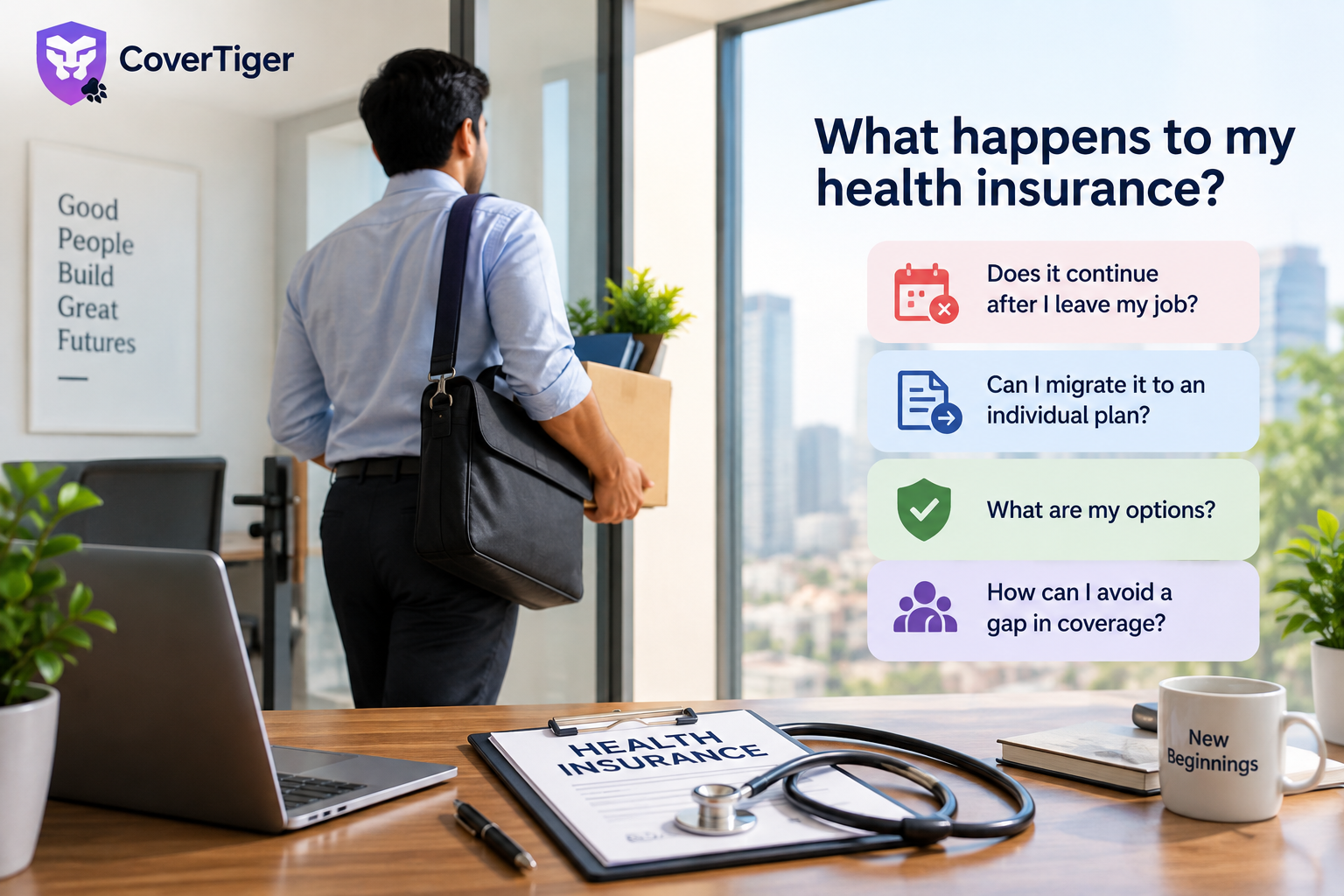
Many employees in India receive health insurance as part of their employee benefits package. It can cover the employee and, depending on the employer's group policy, may also cover a spouse, children or parents.
But an important question often comes up when you resign or change jobs:
“What happens to my health insurance when I leave my company?”
In most cases, employer-provided health insurance is linked to the employer's health insurance plan, so your coverage may end when your employment or membership in the group ends. However, leaving a job does not necessarily mean you lose every opportunity to maintain health insurance protection. IRDAI provides a migration facility for members of group health insurance, allowing eligible members to move to an individual health policy or family floater policy with the same insurer, subject to applicable terms and underwriting.
That means the safest approach is not to wait until your last working day. You should understand your employer policy, ask the insurer or HR team about your options and arrange personal health insurance before a coverage gap occurs.
Quick Answer: Does Employer Health Insurance Continue After Leaving a Job?
Usually, employer-provided group health insurance does not continue automatically after you leave the employer.
A group policy generally covers people while they remain eligible members of the group. IRDAI's health-insurance guidance recognises migration from a group policy to an individual or family floater policy when a member exits the group.
The exact end date of your cover depends on the employer's group policy and insurer's terms.
So, when you resign or change jobs, do not assume that your company health insurance will remain active until the end of the financial year or until the next job starts.
Check the actual policy terms and your coverage end date.
What Is Employer Health Insurance?
Employer health insurance is generally a group health insurance policy arranged by an employer for eligible employees.
Depending on the policy, it may cover:
- The employee
- Spouse
- Dependent children
- Parents
- In-laws
- Hospitalisation expenses
- Day-care procedures
- Certain pre- and post-hospitalisation expenses
- Other benefits specified in the group policy
The exact coverage varies from employer to employer.
Two companies can provide very different group health insurance benefits even if both offer “health insurance".
For example, one employer may provide ₹5 lakh of coverage, while another may provide ₹10 lakh, with different room-rent conditions, different waiting periods or different family coverage.
That is why employees should read their certificate of insurance, policy schedule or group policy summary rather than relying only on what HR describes verbally.
What Happens to Your Health Cover When You Resign?
When you leave your employer, you usually stop being an eligible member of the employer's group health policy.
IRDAI's migration guidelines specifically state that individual members, including family members covered under an indemnity-based group health insurance policy, should have an option to migrate from that group policy to an individual health insurance policy or family floater policy at the time of exit from the group.
This is important because your employment status and your personal health insurance are two different things.
Your employer policy may end.
Your company-sponsored cover may stop when your employment relationship ends or when the insurer receives the employee exit information, depending on the policy process.
Your personal policy can continue independently.
A personal individual or family health policy is not tied to your employer in the same way.
That is one reason many employees choose to arrange their cover while they are still employed.
Does Health Insurance End Immediately on Your Last Working Day?
Not necessarily.
The exact date depends on the terms of the group policy and how the employer and insurer process employee exits.
Some policies specify how coverage is handled after resignation or termination, while others may provide specific migration procedures.
Therefore, do not assume either of these statements is always correct:
“My insurance definitely ends on my last day.”
or
“My insurance definitely continues for 30 days after I leave.”
The correct answer is found in your employer's group policy and insurer's applicable terms.
What should you ask HR?
Before leaving, ask:
- What is my insurance coverage end date?
- Are my dependents covered until the same date?
- Can I migrate the policy to an individual plan?
- Which insurer handles the migration?
- What documents are required?
- What is the deadline for applying?
- What sum insured can be carried forward?
- Will my waiting-period credits continue?
Getting these answers in writing can help avoid confusion later.
What Is Health Insurance Migration?
Migration is the facility that allows a policyholder covered under a health insurance policy to move to another health insurance policy with the same insurer while carrying applicable continuity credits.
IRDAI defines migration as the facility to transfer credits gained from a previous health insurance policy to another policy with the same insurer.
For group health insurance, IRDAI's migration guidelines provide an option for individual members, including family members, to migrate from the group policy to an individual health insurance policy or family floater policy when they exit the group.
Why does migration matter?
Without understanding migration, an employee may assume that leaving a job means starting health insurance from zero.
Depending on the applicable rules and policy terms, migration may preserve certain credits relating to the following:
- Previous sum insured
- Cumulative bonus, where applicable
- Waiting periods
- Pre-existing disease waiting periods
- Time-bound exclusions
IRDAI's current health-insurance FAQ states that migration and portability can transfer credits including sum insured, no claim bonus, specified waiting periods, PED waiting period and other applicable credits.
Migration vs Portability: What Is the Difference?
Confused between health insurance plans?
Let AI decide for you.
- AI compares 30+ insurers
- No sales pressure
- Result in 60 seconds
- 100% free
No spam. No calls unless you want them.
These two terms are often confused.
Migration
Migration is generally a move from one policy to another with the same insurer.
Portability
Portability means moving health insurance coverage to a different insurer, with applicable continuity credits transferred under the rules. IRDAI states that portability is available for individual, family floater and group health insurance policies at renewal.
A simple way to remember it:
Migration = same insurer
Portability = different insurer
This distinction is important when you leave an employer and want to decide whether to stay with the existing insurer or choose another provider.Will Your Pre-Existing Disease Waiting Period Continue?
This query is one of the most important questions for employees who already have medical conditions.
If your employer's group health insurance has provided continuous coverage, applicable continuity credit may be considered when migrating or porting according to IRDAI rules and the terms of the new policy.
IRDAI's migration guidelines state that migration applies to the extent of the previous sum insured and cumulative bonus and that only the unexpired or residual waiting period for pre-existing diseases and time-bound exclusions, subject to the applicable limits, should apply on migration.
This means:
Do not assume that leaving your job automatically resets every waiting period.
At the same time, do not assume that every benefit automatically transfers in full.
The amount of continuity credit and the coverage available under the new policy should be checked carefully.
Example: What Happens When an Employee Leaves?
Suppose Priya has health insurance through her employer.
Her coverage includes:
- Employee: Priya
- Sum insured: ₹10 lakh
- Existing health condition: Diabetes
- Group policy with her employer's insurer
She resigns in June.
Her first step is to confirm:
1. When does her employer's coverage end?
2. Is migration available?
3. What individual or family floater products are available with the same insurer?
4. What continuity credit will be carried forward?
5. What documents must be submitted?
If she migrates under the applicable rules, the insurer may take her previous coverage into account for relevant waiting-period continuity, subject to the policy and underwriting requirements.
If she instead buys an entirely new policy from another insurer, she should understand how portability works and whether she is applying within the applicable renewal window.
What If You Change Jobs?
Changing jobs is slightly different from simply leaving employment because there may be a new employer-provided health policy waiting at the other company.
For example:
Company A → Resignation → Gap of 20 days → Company B
During those 20 days, you should not assume that your old company policy or your new employer's insurance covers you.
Your new employer's group insurance may begin only after you join and become eligible under that employer's policy.
Why should you avoid a coverage gap?
A gap can create financial and administrative problems, particularly if:
- You have a pre-existing condition
- You have dependents
- You are undergoing ongoing treatment
- You have senior parents
- You are expecting planned hospitalisation
- You rely heavily on employer-sponsored cover
Planning personal insurance before changing jobs can provide an additional layer of protection.
Should You Buy Individual Health Insurance Even If Your Employer Provides Cover?
For many employees, maintaining a personal policy alongside employer coverage can be worth considering.
Employer insurance has an important advantage:
Your employer pays or subsidises the premium.
But it also has a major limitation:
Your coverage is connected to your employment.
An individual policy, on the other hand, is owned by you and is not dependent on staying with a particular employer.
This can be particularly relevant for:
- People changing jobs frequently
- Self-employed individuals
- Employees planning retirement
- Employees with dependents
- People with existing medical conditions
- People who want higher coverage than their employer provides
The best approach depends on your finances and existing coverage.
What Are the Benefits of Having Personal Health Insurance Alongside Employer Cover?
Confused between health insurance plans?
Let AI decide for you.
- AI compares 30+ insurers
- No sales pressure
- Result in 60 seconds
- 100% free
No spam. No calls unless you want them.
1. Protection During Job Changes
Your personal policy can provide continuity while you move from one employer to another.
2. Coverage After Retirement
Employer-sponsored health insurance may not continue after retirement, depending on the scheme.
A personal policy can remain with you subject to its terms and renewal.
3. Higher Overall Coverage
You may be able to use your personal policy as an additional layer if your employer's coverage is limited.
4. Control Over the Policy
You can choose the insurer, the sum insured, and the policy features according to your own requirements.
5. Family Protection
You can structure your personal insurance around your spouse, children or parents rather than depending entirely on an employer's group plan.
What Should You Check Before Leaving Your Job?
Before your last working day, collect important insurance information.
Check Your Sum Insured
Know exactly how much coverage you and your dependents have.
Check Who Is Covered
Confirm whether your spouse, children and parents are included.
Check the Policy Period.
Know when the group policy is due for renewal.
Check the Exit Rules
Find out when your cover ends after resignation, retirement or termination.
Ask About Migration
Ask whether you can migrate to an individual health insurance policy or family floater with the same insurer.
Get Your Insurance Documents
Keep copies of:
- Health card
- Certificate of insurance
- Policy number
- Claims history, where available
- Sum insured details
- Dependent information
- Insurer contact details
These documents can be useful when arranging continued coverage.What If You Already Have an Ongoing Medical Treatment?
This situation requires extra care.
Suppose you are currently receiving treatment for a chronic condition or have a planned hospitalisation coming up when you change jobs.
Do not wait until after your employer coverage ends to ask what happens.
Check:
- Current policy validity
- Hospital network
- Pre-authorisation requirements
- Claim status
- Migration availability
- Continuity benefits
- New policy waiting periods
- Coverage of ongoing treatment
Your employer, insurer or third-party administrator can provide the policy-specific answer.
What If Your Employer Changes the Insurance Company?
Sometimes employees remain with the same employer, but the company changes its group health insurer at renewal.
This is different from an employee changing jobs.
If the employer changes insurers, the treatment of continuity and waiting-period credits depends on the applicable regulations, transition arrangements and policy terms.
IRDAI's health-insurance framework recognises migration and portability mechanisms designed to preserve applicable continuity credits in qualifying situations.
Employees should therefore ask HR and the new insurer exactly how they will handle existing waiting periods and benefits.
Can You Port Employer Health Insurance to Another Insurer?
Portability is a regulated facility, but timing matters.
IRDAI's current FAQ states that portability applies to individual, family floater and group health insurance policies at renewal. It also states that a policyholder seeking to port should apply to the new insurer at least 30 days before renewal and not earlier than 60 days before the renewal date.
This is different from simply buying a brand-new health policy.
The objective of portability is to transfer applicable continuity credits rather than forcing the customer to start entirely from scratch.
Because the timing and documentation matter, employees should start the process well before the existing policy expires.
How to Avoid a Health Insurance Gap When Changing Jobs
A practical approach is:
Step 1: Find Out Your Current Coverage
Check your employer policy, sum insured, dependents and policy end date.
Step 2: Ask HR About Exit Coverage
Confused between health insurance plans?
Let AI decide for you.
- AI compares 30+ insurers
- No sales pressure
- Result in 60 seconds
- 100% free
No spam. No calls unless you want them.
Get the exact date on which your insurance stops.
Step 3: Ask the Insurer About Migration
Find out what individual or family floater options are available.
Step 4: Compare Personal Policies
Compare coverage, exclusions, waiting periods, room-rent limits, co-payments, deductibles, claim process and network hospitals.
Step 5: Arrange New Cover Before the Old Cover Ends
Do not leave the process until the final day.
Step 6: Keep Documents Safely
Retain the group policy details and records needed for migration or portability.
Common Mistakes Employees Make
Mistake 1: Assuming Employer Insurance Is Permanent
It is usually linked to employment and the group policy.
Mistake 2: Waiting Until After Resignation
Once you are close to the exit date, you may have less time to arrange alternative coverage.
Mistake 3: Buying the Cheapest Personal Policy
Premium is only one part of the comparison.
Mistake 4: Ignoring Existing Medical Conditions
Your medical history should be disclosed accurately when applying for personal health insurance.
Mistake 5: Forgetting About Dependents
Your spouse, children or parents may lose group coverage along with you.
Mistake 6: Assuming Every Benefit Transfers
Migration or portability can transfer applicable continuity credits, but the new policy may have different terms and benefits.
Frequently Asked Questions
Does health insurance stop when I leave my job?
Usually, employer-sponsored group health insurance is linked to your membership in the employer's group. Coverage can therefore end when you leave employment, subject to the terms of the group policy.
Can I keep my employer's health insurance after resignation?
You may have an option to migrate from the group policy to an individual health policy or family floater with the same insurer, subject to applicable rules and underwriting.
What is migration in health insurance?
Migration means transferring applicable continuity credits from one health insurance policy to another policy with the same insurer.
What is portability in health insurance?
Portability allows a health insurance policyholder to transfer applicable continuity credits when moving from one insurer to another, subject to the rules and timing requirements.
Will my pre-existing disease waiting period restart after I leave my job?
Not necessarily. Under applicable migration and portability rules, continuity credits for pre-existing disease waiting periods may be transferred, subject to the regulations, previous coverage and the terms of the new policy.
Can I get individual health insurance after leaving my employer?
Yes. You can explore an individual health insurance policy or family floater. If you are migrating from a group policy, check the insurer's migration process and deadlines.
Should I buy personal health insurance if my company already provides it?
For many people, having personal coverage in addition to employer insurance can provide greater continuity and flexibility, particularly during job changes or retirement.
Can I port my employer's policy to another insurer?
Portability may be available at renewal under the applicable rules. IRDAI's current FAQ provides a renewal-window process for portability applications.
Will my parents remain covered after I leave my job?
Not necessarily. Their continued coverage depends on the employer's group policy and the available migration or replacement options. Confirm the dependent exit rules before leaving.
What happens to health insurance when I retire?
Employer coverage may end depending on the employer's policy. Retirement is therefore another reason to evaluate personal health insurance before the group cover ends.
Final Thoughts
Employer-sponsored health insurance is a valuable employee benefit, but it should not be treated as your only long-term health protection.
When you leave or change jobs, your group health insurance may end because your eligibility as an employee ends. However, migration and portability mechanisms can provide ways to maintain continuity, depending on your circumstances and the applicable rules.
The smartest approach is to plan before your employment ends.
Check your current policy, confirm your coverage end date, ask about migration, understand your waiting-period credits and compare personal health insurance options before creating a gap.
Your job can change. Your health insurance strategy should not have to start from zero every time it does.

Written By
Raj Shankar
Principal Officer and General Manager at CoverTiger
With over 7 years of experience in the insurance and fintech industry, Raj Shankar has helped 10,000+ customers secure their families with the right insurance solutions. He has worked with leading brands such as Policybazaar, INDmoney, and CoverTiger, building strong expertise in health insurance, life insurance, sales leadership, and customer advisory. His mission is to make insurance simpler, more transparent, and accessible for every Indian family.