If your company already provides health insurance, you may have wondered:
“Why should I buy another health insurance policy when my employer already covers me?”
It is a completely reasonable question.
Employer-provided health insurance can give you valuable financial protection against medical expenses. But it may not always be enough for your family, and your coverage may depend on your employment.
So, do you actually need personal health insurance if you already have employer health insurance?
In many situations, having personal health insurance in addition to your employer coverage can provide greater financial protection and continuity. However, the right decision depends on your current coverage, family responsibilities, health needs, budget, and future plans.
Let's understand how to decide.
What Is Employer Health Insurance?
Employer health insurance, also known as group health insurance or corporate health insurance, is health coverage provided by an employer as an employee benefit.
Depending on the policy, it may cover:
- Hospitalisation expenses
- Pre- and post-hospitalisation expenses
- Day-care procedures
- Certain medical treatments
- Employees and eligible family members
- Other benefits specified in the policy
However, the exact benefits vary from one employer and policy to another.
For example, one company may provide ₹5 lakh of coverage, while another may provide ₹10 lakh or more. Some policies may include dependents, while others may have different rules for spouses, children, or parents.
That's why simply knowing that your company provides health insurance is not enough.
You need to understand what your policy actually covers.
Is Employer Health Insurance Enough?
There is no single answer that works for everyone.
Your employer health insurance may be enough for your current needs, or you may have significant coverage gaps.
Before depending entirely on your corporate policy, ask yourself:
- How much coverage do I have?
- Who is covered under the policy?
- Are my spouse and children covered?
- Are my parents covered?
- What hospitals can I use?
- Are there room-rent limits?
- Are there co-payment requirements?
- Are there waiting periods?
- What treatments are excluded?
- What happens if I change jobs?
- Would my coverage be enough during a major medical emergency?
For example, suppose you have ₹5 lakh of employer health insurance.
If your family experiences a large hospitalisation expense that exceeds the eligible coverage available under your policy, you may have to pay the remaining amount yourself, depending on the policy terms.
So the real question isn't:
“Does my employer give me health insurance?”
The better question is:
“Is my current health insurance enough for my actual needs?”
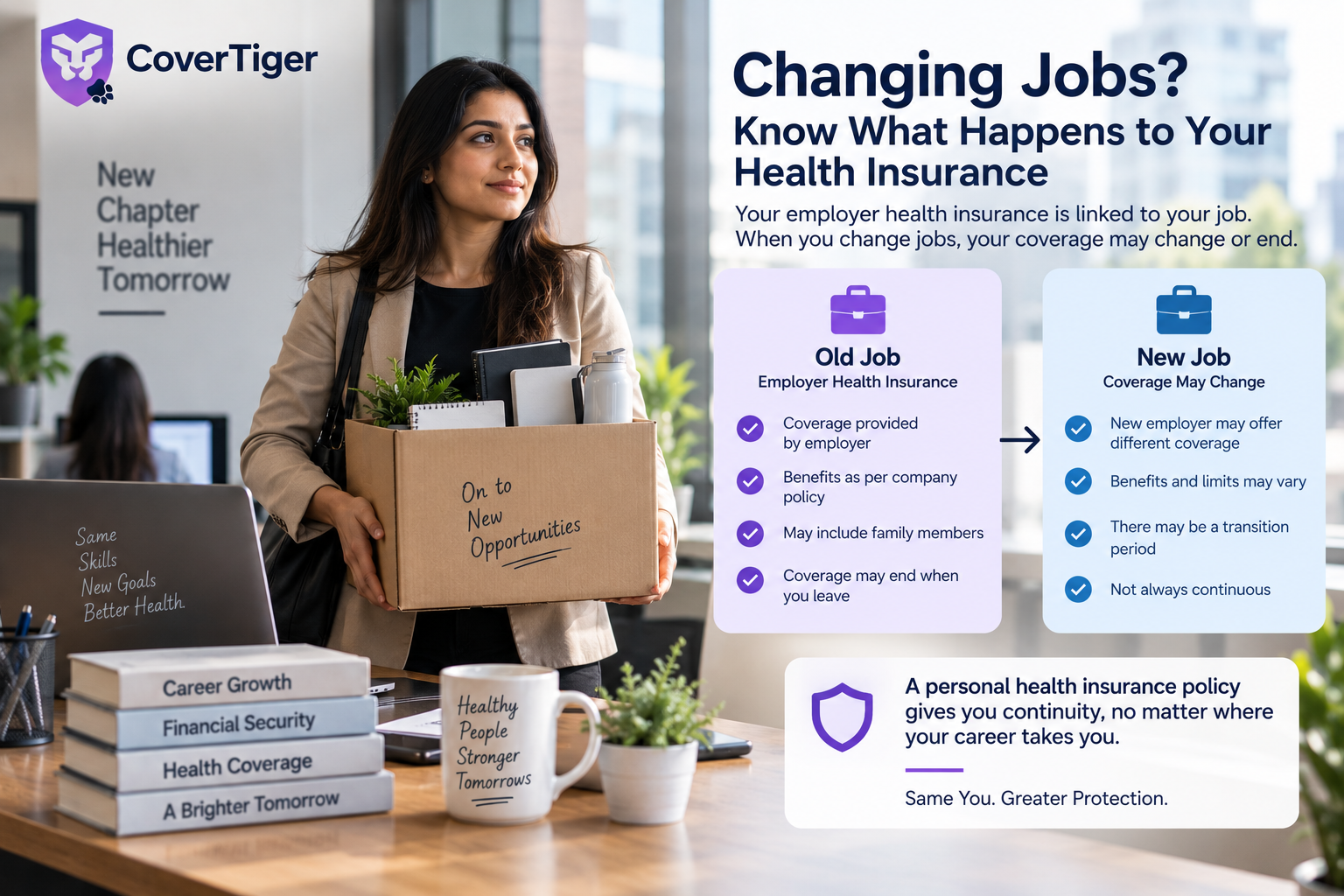
What Happens to Your Health Insurance When You Change Jobs?
This is one of the biggest reasons people consider personal health insurance.
Your employer's health insurance is connected to the group policy arranged by your employer. If you leave your job, retire, or move to another company, your coverage may change or end according to the policy terms.
Imagine this situation:
You are 32 years old, married, and have one child. Your employer provides ₹5 lakh of health insurance.
You decide to switch jobs.
Your new employer may provide a different level of coverage, different benefits, or different terms. Depending on the circumstances, there could also be a transition period.
A personal health insurance policy gives you an additional layer of protection that is not dependent on your current employer in the same way.
Always check your existing group policy for its specific continuation, conversion, or portability provisions before making assumptions about what happens after employment ends.
Employer Health Insurance vs Personal Health Insurance
| Factor | Employer Health Insurance | Personal Health Insurance |
|---|---|---|
| Who purchases it? | Employer | You |
| Connected to employment? | Generally yes | No |
| Who selects the policy? | Employer | You |
| Coverage options | Based on employer's policy | You select from available policies |
| Family coverage | Depends on employer policy | Based on the policy you choose |
| Control over coverage | Limited | Greater control |
| Coverage after changing jobs | May be affected | Not dependent on employer |
| Customisation | Usually limited | More choice |
| Premium | Usually employer-paid or subsidised | Paid by you |
These two types of health insurance don't necessarily have to compete with each other.
For many people, they can work together.
Why Consider Personal Health Insurance If Your Employer Already Covers You?
Confused between health insurance plans?
Let AI decide for you.
- AI compares 30+ insurers
- No sales pressure
- Result in 60 seconds
- 100% free
No spam. No calls unless you want them.
1. Your Coverage Isn't Completely Dependent on Your Job
Your employer can change its insurance provider, benefits, coverage amount, or policy structure.
A personal policy gives you an additional layer of protection that you control.
2. You May Need More Coverage
Your corporate policy may not provide the amount of coverage you would want for your family's needs.
For example, if your employer provides ₹5 lakh of coverage and you believe your family's potential healthcare expenses could require more protection, you can explore additional coverage.
The right amount depends on factors such as:
- Family size
- Age
- City
- Healthcare costs
- Existing medical conditions
- Financial situation
- Existing insurance coverage
3. Your Family May Not Be Adequately Covered
Your employer may cover you but have different rules for your spouse, children, or parents.
If your family members aren't adequately protected under the corporate policy, you may want to consider separate or additional health insurance based on their needs.
4. You Have More Control Over the Policy
With personal health insurance, you can compare policies based on factors such as:
- Sum insured
- Network hospitals
- Waiting periods
- Room-rent limits
- Co-payment
- Exclusions
- Restoration benefits
- No-claim benefits
- Claim-related terms
This gives you more control over the protection you choose.
5. You Can Plan for the Long Term
Your employer benefits can change throughout your career.
You may change jobs, become self-employed, retire, or move to an employer with different benefits.
Having your own health insurance can help you plan beyond your current employment situation.
Can I Have Both Employer and Personal Health Insurance?
Yes, you can have both employer-provided health insurance and personal health insurance.
However, having two policies does not mean you can receive duplicate reimbursement for the same medical expense.
If you need to use more than one policy, claims need to be handled according to the respective policy terms and applicable claim procedures.
You should also disclose your existing health insurance policies to insurers whenever required.
The purpose of having both policies is to create broader financial protection, not to claim the same expense twice.
What If My Employer Already Gives Me ₹10 Lakh of Coverage?
A higher employer cover can provide substantial protection, but you should still review the policy before deciding that you don't need anything else.
Check:
- Who is covered?
- Are your spouse and children included?
- Are your parents covered?
- What are the exclusions?
- Are there room-rent restrictions?
- Are there disease-specific limits?
- What waiting periods apply?
- What happens when you leave the company?
- Is the coverage likely to remain adequate as your family grows?
If your employer coverage genuinely meets your current and foreseeable needs, you may decide that additional coverage isn't immediately necessary.
The important thing is to make an informed decision rather than assuming employer coverage is automatically enough.
What About Parents?
Parents require special consideration.
Many employer policies have specific rules around parent coverage, including eligibility, coverage amounts, premiums, waiting periods, and other conditions.
As parents get older, their healthcare needs can also increase.
If your employer's policy doesn't adequately protect your parents, you may want to explore separate health insurance for them.
Their age, health conditions, existing coverage, and expected healthcare needs should all be considered.
What Should You Check Before Buying Personal Health Insurance?
Don't select a policy only because it has the lowest premium.
1. Coverage Amount
Confused between health insurance plans?
Let AI decide for you.
- AI compares 30+ insurers
- No sales pressure
- Result in 60 seconds
- 100% free
No spam. No calls unless you want them.
Choose coverage based on your family's potential healthcare needs and financial situation.
2. Network Hospitals
Check whether hospitals you may realistically use are included in the insurer's network.
3. Waiting Periods
Understand waiting periods for pre-existing conditions and specific treatments.
4. Exclusions
Know what the policy does not cover.
5. Room-Rent Limits
Check whether the policy restricts the room category you can choose during hospitalisation.
6. Co-Payment
Understand whether you will have to pay a percentage of eligible expenses yourself.
7. Claim Process
Understand how claims work and what documents may be required.
8. Family Coverage
Make sure the people you want to protect are eligible and appropriately covered.
9. Renewal Terms
Understand the policy's renewal conditions and long-term implications.
A Real-Life Example
Let's take Rahul.
Rahul is 32, married, has one child, and works for a private company.
His employer provides ₹5 lakh of health insurance.
Initially, he thinks:
“I already have health insurance, so I don't need another policy.”
But Rahul reviews his situation.
He discovers that:
- His employer coverage may change if he changes jobs.
- His family has healthcare needs beyond his own.
- His parents aren't adequately covered.
- He wants more control over his health insurance.
- He wants protection that isn't dependent entirely on his employer.
Instead of immediately buying a policy, Rahul first compares his existing coverage with his family's actual needs.
This helps him identify whether he has a coverage gap and whether additional personal health insurance makes sense.
The lesson isn't that everyone must buy another policy.
The lesson is:
Don't assume your employer's health insurance is enough without understanding what it covers and whether it matches your needs.
Not Sure If Your Employer Health Insurance Is Enough?
This is where personalized guidance can be useful.
Instead of simply looking at premiums, you need to consider your:
- Age
- Family members
- City
- Existing coverage
- Health situation
- Budget
- Future healthcare needs
Ira, CoverTiger's Health Insurance AI Advisor, can help you understand your requirements, compare suitable health insurance options, and explain important differences between plans in simple language.
The goal isn't simply to show you more policies.
The goal is to help you understand:
“What kind of health insurance protection actually makes sense for my situation?”
5 Questions You Should Ask Before Relying Only on Employer Insurance
Confused between health insurance plans?
Let AI decide for you.
- AI compares 30+ insurers
- No sales pressure
- Result in 60 seconds
- 100% free
No spam. No calls unless you want them.
Before deciding that your employer health insurance is enough, ask:
1. How much health insurance coverage do I actually have?
Don't just check the headline coverage amount. Understand the applicable limits and conditions.
2. Who is covered?
Check whether your spouse, children, and parents are included.
3. What happens if I change jobs?
Understand what happens to your current coverage when your employment ends.
4. Are there important exclusions or waiting periods?
Read the policy terms carefully, especially if you or your family members have existing health conditions.
5. Would my family be financially comfortable if a major medical expense occurred?
This is ultimately the most important question.
When Should You Consider Personal Health Insurance?
There is no single perfect age to buy health insurance.
However, you may want to review your insurance needs when:
- You start working
- You get married
- You have children
- Your parents need additional protection
- You take on major financial responsibilities
- You change jobs
- Your employer changes its insurance benefits
- Your current coverage no longer matches your needs
The earlier you understand your healthcare needs, the easier it can be to plan your coverage.
Frequently Asked Questions
Is employer health insurance enough?
It can be enough for some people, but it depends on the coverage amount, people covered, policy terms, exclusions, waiting periods, and your family's healthcare needs.
Can I have employer and personal health insurance at the same time?
Yes. You can have both, subject to the respective policy terms and applicable rules.
What happens to my corporate health insurance when I leave my job?
Your group coverage may be affected when your employment ends. Check the terms of your employer's policy for applicable continuation or portability options.
Should I buy personal health insurance if my company provides ₹5 lakh coverage?
It depends on your individual circumstances. Review your family size, healthcare needs, current coverage, policy limitations, and future requirements before deciding.
Should I buy separate health insurance for my parents?
If your parents aren't adequately covered under your employer's policy, a separate policy may be worth considering based on their age, health conditions, healthcare requirements, and available policy terms.
Can I use both employer and personal health insurance for one hospitalisation?
Potentially, depending on the circumstances and policy terms. However, you cannot receive duplicate reimbursement for the same expense. Follow the applicable claim and coordination process.
What is the biggest disadvantage of relying only on employer health insurance?
The main concern is that your coverage is connected to an employer-sponsored policy. Your benefits may change when you change jobs or when your employer changes its insurance arrangements.
Final Takeaway
Employer health insurance is a valuable employee benefit, but it shouldn't automatically be treated as your complete long-term health insurance strategy.
Your employer's policy may provide useful protection while you are employed. Personal health insurance can provide additional protection and reduce your dependence on your employer's benefits.
Before making a decision, look at:
Your age + family + existing coverage + health needs + financial responsibilities + policy terms + future plans.
If your employer's insurance already meets your needs, you may not need additional coverage immediately.
But if you identify gaps, personal health insurance may help close them.
And if you're unsure where to start, Ira, CoverTiger's Health Insurance AI Advisor, can help you understand your needs, compare suitable options, and make a more informed insurance decision.
The goal isn't to buy more insurance. The goal is to have the right protection for your actual needs.

Written By
Raj Shankar
Principal Officer and General Manager at CoverTiger
With over 7 years of experience in the insurance and fintech industry, Raj Shankar has helped 10,000+ customers secure their families with the right insurance solutions. He has worked with leading brands such as Policybazaar, INDmoney, and CoverTiger, building strong expertise in health insurance, life insurance, sales leadership, and customer advisory. His mission is to make insurance simpler, more transparent, and accessible for every Indian family.