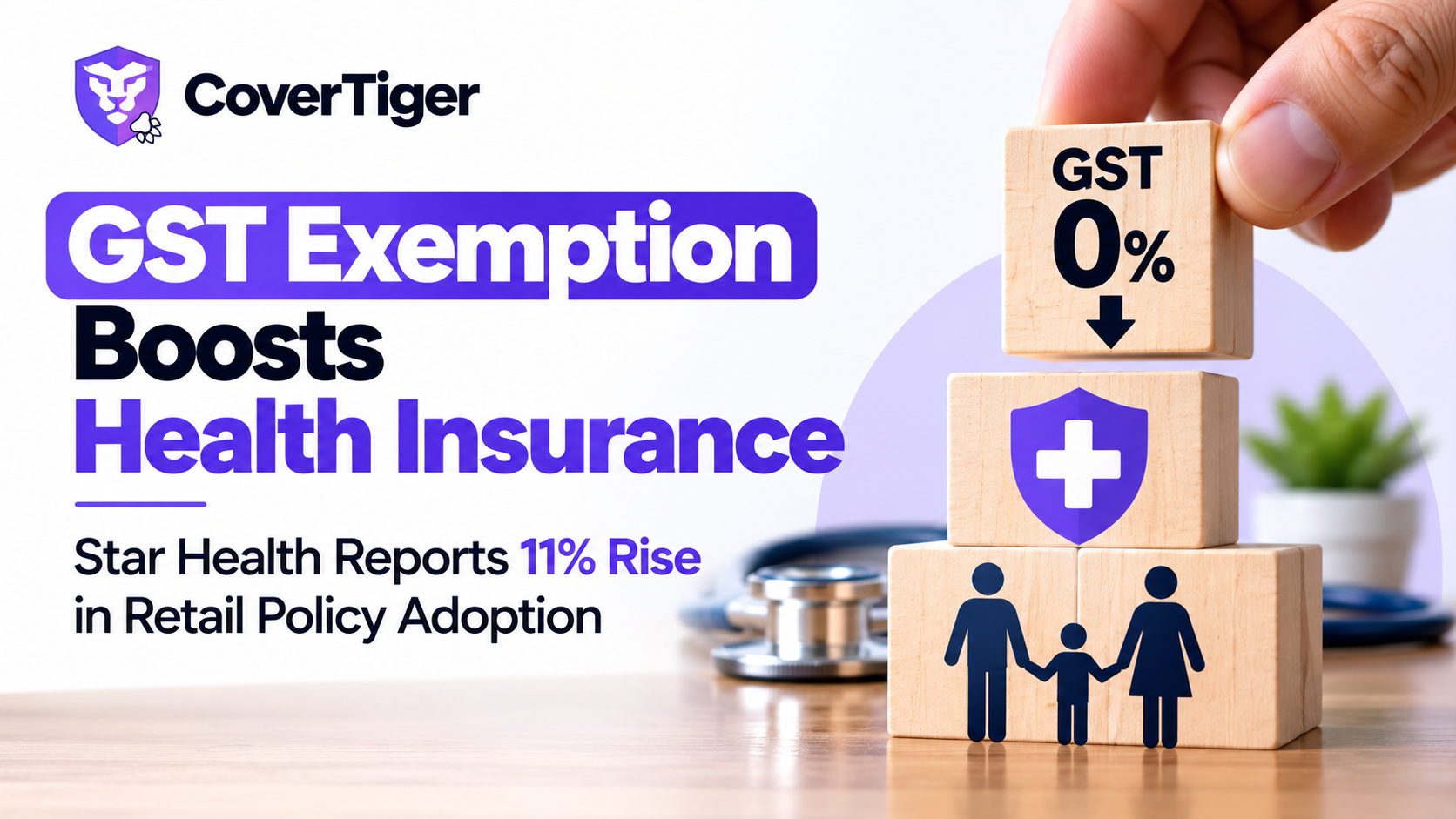
GST Exemption Boosts Health Insurance: Star Health Reports 11% Rise in Retail Policy Adoption
The removal of GST on individual health insurance premiums appears to be influencing how Indians buy health insurance, with Star Health reporting an 11% rise in its retail policy base during the 11 months from October 2025 to August 2026.
The latest update, reported by PTI and published by The Economic Times on September 27, 2026, also shows that the average sum insured on new retail health indemnity policies increased by around ₹1.4 lakh to ₹13.7 lakh compared with the year-earlier period.
The development comes about a year after GST on individual health insurance premiums was reduced from 18% to zero, effective September 22, 2025. The exemption covers individual health insurance policies, including family floater plans.
What Changed With GST on Health Insurance?
Before September 22, 2025, individual health insurance premiums attracted 18% GST.
Under the revised GST framework, individual health insurance policies became exempt from GST. The exemption applies to individual health insurance policies, including family floater plans, while group health insurance policies continue to attract 18% GST.
For example, if a health insurance policy had a base premium of ₹30,000, an 18% GST component would previously have added ₹5,400 to the amount payable.
With GST exemption, that tax component is no longer added to the premium under the individual-policy structure.
However, the actual premium charged by an insurer can still vary based on factors such as age, medical risk, coverage, policy benefits and insurer pricing.
Star Health Reports 11% Growth in Retail Policies
According to Star Health's statement reported by PTI, its retail policy base grew by more than 11% during October 2025–August 2026, compared with approximately 2% growth during the corresponding period a year earlier.
The company also reported an increase in new-to-insurance customers and greater penetration in Tier II, Tier III and Tier IV markets.
Consumers between 26 and 50 years of age accounted for more than 80% of net policy additions during the period, according to the company.
It is important to note that these figures are Star Health's company-level data, not an industry-wide measurement.
Average Health Insurance Cover Also Increased
Star Health reported that the average sum insured on new retail health indemnity policies increased by approximately ₹1.4 lakh to ₹13.7 lakh during October 2025–August 2026 compared with the year-earlier period.
This is important because buying health insurance is not simply about having a policy. The amount of coverage also matters.
Medical expenses can vary significantly depending on the treatment, hospital, city and length of hospitalisation. As a result, consumers need to consider whether their sum insured is sufficient rather than selecting a policy based only on the premium.
Does Zero GST Mean Health Insurance Is Automatically Cheaper?
Not necessarily.
The GST exemption removes the tax previously charged on eligible individual health insurance premiums. However, the final premium offered by an insurer depends on several other factors.
These can include:
- Age of the insured
- Medical history
- Sum insured
- Family composition
- Policy benefits
- Deductibles
- Claims experience
- Product design
- Insurer pricing
Therefore, consumers should distinguish between GST savings and the insurer's actual premium.
The GST exemption reduces the tax component, but it does not mean every health insurance policy will have the same final price.
Are People Buying Higher Health Insurance Cover?
The latest Star Health data points toward higher average coverage among its new retail health indemnity policies.
The insurer reported an increase in average sum insured to ₹13.7 lakh, an increase of around ₹1.4 lakh from the year-earlier period.
This makes the question of how much health insurance coverage a family needs increasingly important.
A buyer should consider factors such as:
Confused between health insurance plans?
Let AI decide for you.
- AI compares 30+ insurers
- No sales pressure
- Result in 60 seconds
- 100% free
No spam. No calls unless you want them.
- Number of family members
- Age of family members
- Existing medical conditions
- City and healthcare costs
- Existing employer coverage
- Current individual health insurance
- Expected future healthcare requirements
Instead of choosing a fixed amount simply because it is popular, consumers should evaluate the level of protection that fits their circumstances.
Why Are Younger and Middle-Aged Buyers Important?
According to Star Health, customers aged 26 to 50 accounted for more than 80% of net policy additions during the reported period.
This age group includes many working professionals, young families and people who may be purchasing health insurance independently for the first time.
For such buyers, an early health insurance policy can also raise questions about:
- Individual vs family floater coverage
- Coverage amount
- Waiting periods
- Pre-existing disease conditions
- Hospital network
- No-claim benefits
- Room-rent limits
- Deductibles
- Policy renewal
The right comparison therefore requires more than checking the premium.
What About Family Floater Health Insurance?
The GST exemption also covers individual family floater health insurance policies.
A family floater allows multiple eligible family members to share a common sum insured under the policy.
For example, a family could have a ₹10 lakh family floater rather than buying separate ₹10 lakh policies for every member.
However, the suitability of a family floater depends on factors such as the family's age profile, medical needs and expected healthcare expenses.
You can explore family health insurance plans when comparing different coverage structures.
What Should You Compare Before Buying Health Insurance in 2026?
Even with the GST exemption, the cheapest premium should not automatically become the main selection factor.
1. Sum Insured
Check whether the coverage amount is appropriate for your family and healthcare requirements.
2. Waiting Periods
Look at waiting periods for pre-existing diseases and specific treatments.
3. Hospital Network
Check whether hospitals you may realistically use are part of the insurer's network.
4. Deductibles
Understand how much you may need to pay yourself before insurance coverage applies.
5. Room-Rent Limits
A room-rent restriction can affect the amount payable during hospitalisation.
6. Co-Payment
Check whether you are required to pay a percentage of eligible claim expenses yourself.
7. Exclusions
Read what the policy does not cover, rather than looking only at the list of benefits.
Confused between health insurance plans?
Let AI decide for you.
- AI compares 30+ insurers
- No sales pressure
- Result in 60 seconds
- 100% free
No spam. No calls unless you want them.
8. Claim Conditions
Understand the documentation and notification requirements before purchasing.
Consumers can use an online health insurance comparison approach to evaluate these factors together.
Can an AI Health Insurance Advisor Help You Compare Plans?
As health insurance options become more varied, comparing policies manually can become difficult.
An AI Health Insurance Advisor can help organise different policy features, including:
- Coverage
- Premium
- Waiting periods
- Deductibles
- Exclusions
- Hospital networks
- Co-payment
- Policy benefits
At CoverTiger, Ira is the AI Health Insurance Advisor designed to help users understand and compare health insurance options.
Instead of looking only at the price, users can use an AI-powered comparison approach to examine multiple policy factors together.
Explore CoverTiger Health Insurance Plansand compare the features relevant to your requirements.
The final decision should always be based on the actual policy wording, eligibility conditions and individual insurance needs.
What Does the GST Exemption Mean for Existing Policyholders?
For an existing individual health insurance policy, the GST exemption affects the tax treatment of the eligible premium.
However, consumers should not assume that every change in renewal premium is solely because of GST.
Renewal premiums can be influenced by several factors, including:
- Age
- Product pricing
- Medical inflation
- Claims experience
- Changes in benefits
- Insurer pricing decisions
- Regulatory changes
Therefore, when renewing a policy, compare the total premium and policy benefits, rather than looking at the GST component alone.
Individual vs Group Health Insurance: Does the GST Exemption Apply to Both?
No.
The GST exemption applies to individual life and individual health insurance policies, including family floater health policies.
Group insurance policies continue to attract 18% GST.
This distinction is important for employees who already receive health insurance through their employer.
Employer-provided health insurance and personally purchased health insurance should not automatically be treated as identical forms of protection.
Is GST Exemption Increasing Health Insurance Adoption Across India?
The latest Star Health data indicates increased retail policy adoption within its own portfolio.
The company also reported greater penetration in Tier II, III and IV markets and an increase in new-to-insurance customers.
However, it is important not to treat Star Health's 11% growth as an industry-wide growth figure.
The broader market impact will become clearer as more industry data becomes available.
What Should Health Insurance Buyers Do in 2026?
The GST exemption can reduce the tax burden on eligible individual health insurance premiums, but buying health insurance still requires a broader comparison.
Confused between health insurance plans?
Let AI decide for you.
- AI compares 30+ insurers
- No sales pressure
- Result in 60 seconds
- 100% free
No spam. No calls unless you want them.
Before purchasing or renewing a policy, ask:
How much coverage do I need?
Who needs to be covered?
What waiting periods apply?
Are my preferred hospitals included?
What deductibles or co-payments apply?
What exclusions should I know about?
What will I actually pay during a claim?
These questions can help you evaluate the policy beyond its headline premium.
Frequently Asked Questions
Is GST zero on individual health insurance in India?
Yes. GST on individual health insurance premiums was reduced from 18% to zero from September 22, 2025. The exemption includes individual family floater health insurance policies.
Does the GST exemption apply to group health insurance?
No. Group health insurance policies continue to attract 18% GST.
Did Star Health's retail policy base increase after the GST exemption?
Star Health reported that its retail policy base grew by more than 11% during October 2025–August 2026, compared with around 2% in the corresponding period a year earlier.
What happened to the average sum insured on new Star Health policies?
Star Health reported that the average sum insured on new retail health indemnity policies increased by approximately ₹1.4 lakh to ₹13.7 lakh during October 2025–August 2026 compared with the year-earlier period.
Does zero GST mean every health insurance policy is cheaper?
Not necessarily. The GST exemption removes the applicable GST component, but the underlying premium can still vary based on age, medical risk, coverage, product design, claims experience and insurer pricing.
Are family floater health insurance plans covered by the GST exemption?
Yes. Individual family floater health insurance policies are covered under the GST exemption.
Can an AI Health Insurance Advisor help compare policies?
Yes. An AI Health Insurance Advisor can help organise factors such as coverage, premium, waiting periods, deductibles, exclusions and hospital networks. CoverTiger's Ira is designed to help users understand and compare health insurance options.
Final Takeaway
The latest Star Health data provides an early indication of how the GST exemption may be influencing retail health insurance adoption.
Star Health reported an 11% rise in its retail policy base during October 2025–August 2026, while the average sum insured on new retail health indemnity policies increased to ₹13.7 lakh.
However, these are Star Health's company-level figures, not an industry-wide measure. The broader market impact will become clearer as more industry data becomes available.
For health insurance buyers, the GST exemption is one factor in the overall cost of a policy. The more important step is to compare coverage, waiting periods, exclusions, deductibles, hospital networks and claim conditions before making a decision.
With tools such as CoverTiger's AI Health Insurance Advisor Ira, consumers can organise these factors and make the health insurance comparison process easier.

Written By
Raj Shankar
Principal Officer and General Manager at CoverTiger
With over 7 years of experience in the insurance and fintech industry, Raj Shankar has helped 10,000+ customers secure their families with the right insurance solutions. He has worked with leading brands such as Policybazaar, INDmoney, and CoverTiger, building strong expertise in health insurance, life insurance, sales leadership, and customer advisory. His mission is to make insurance simpler, more transparent, and accessible for every Indian family.