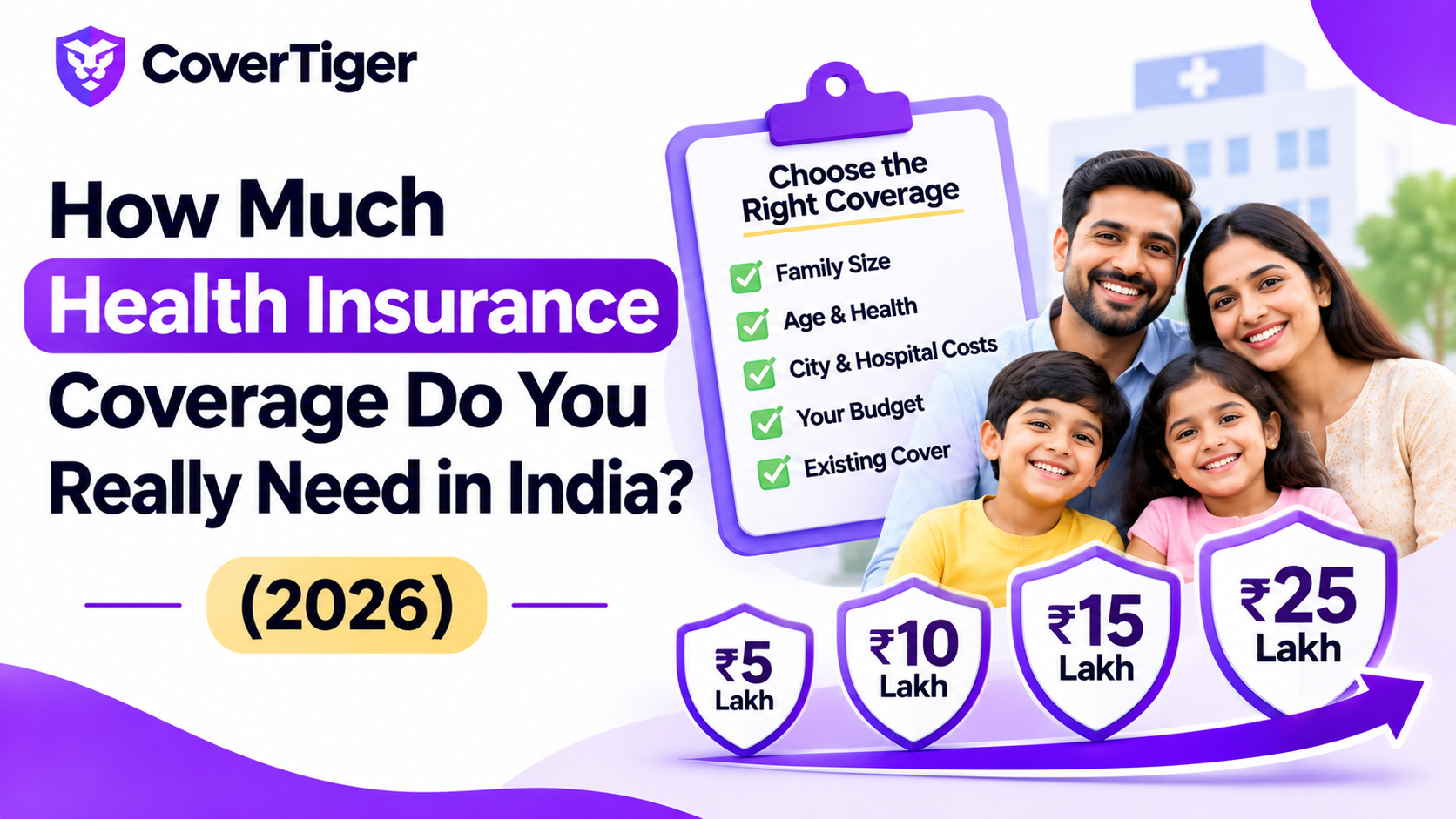
How Much Health Insurance Coverage Do You Really Need in India? (2026)
Choosing health insurance is not just about finding the lowest premium. One of the most important decisions is selecting the right sum insured—the maximum amount the insurer may pay for covered expenses during the policy period, subject to the policy's terms, limits and exclusions.
A ₹5 lakh policy may be adequate for some people, while another family may need a higher cover because of its location, age profile, medical history or preferred hospitals. Buying too little cover can leave you paying a large part of a hospital bill yourself. Choosing a very high cover without understanding the premium and policy conditions may also be an inefficient decision.
So, how much health insurance coverage do you really need in India in 2026? The answer depends on your circumstances. This guide explains how to estimate your requirement, compare common cover amounts and avoid mistakes when choosing a policy.
Why Choosing the Right Health Insurance Coverage Matters
Hospital expenses can vary widely depending on the city, hospital, treatment, room category and complexity of the medical condition. A routine admission and a major surgery will not create the same financial requirement.
Healthcare costs have also been rising. A Milliman analysis published in April 2026 reported medical trend of 12% in 2024 and projected 13% for 2025. These are industry-level estimates, not a prediction of the cost of every treatment or an individual's future premium. They nevertheless show why it is sensible to review health insurance coverage periodically.
The sum insured is only one part of protection. A policy with a large headline cover can still have restrictions such as room-rent limits, co-payments, disease-wise sub-limits, waiting periods or exclusions. Always assess the usable cover and policy wording—not just the number shown in an advertisement.
How Much Health Insurance Coverage Is Enough in India?
There is no fixed amount that is suitable for every Indian household. As a starting point for comparison, you may evaluate base covers of ₹5 lakh, ₹10 lakh, ₹15 lakh and ₹25 lakh. The appropriate option depends on your needs and the policy's premium and conditions.
The following table is an educational comparison, not a personalised recommendation or a guarantee that a particular amount will cover a specific treatment.
| Sum Insured | What to Consider | Who May Evaluate It |
|---|---|---|
| ₹5 lakh | A lower starting level of cover. Check whether it is sufficient for the hospitals and treatments you may use. | People comparing entry-level cover, especially where budget is a major constraint. |
| ₹10 lakh | A higher base limit than ₹5 lakh, although policy restrictions and local hospital costs still matter. | Individuals or smaller families assessing a moderate level of protection. |
| ₹15 lakh | A larger base limit to consider if it fits your healthcare needs and budget. | Families or individuals comparing broader protection against larger hospital bills. |
| ₹25 lakh | A higher headline limit. Compare its premium and terms with a base policy plus a suitable super top-up. | People who prefer a larger financial buffer or expect higher healthcare costs. |
Do not select a sum insured only because it is popular. Compare the policy's benefits, restrictions, hospital network, renewal terms and total cost.
6 Factors That Help You Calculate Your Required Health Insurance Cover
1. Your age and family members' ages
Healthcare needs can change with age. A young individual may have different expected healthcare needs from a couple in their 50s or a family that includes senior parents.
When selecting cover, consider the age of every person who will be insured. If you are buying a family floater, remember that the members share the policy's available sum insured, subject to its terms. A large claim for one member can reduce the remaining amount available to others during that policy year.
2. Your city and preferred hospitals
Hospital charges are not the same across India. Costs can vary between cities, hospitals and even room categories within the same hospital. If you prefer large private hospitals or specialist facilities, compare their likely charges with the cover you are considering.
Check whether your preferred hospitals are in the insurer's network. Network status can change, so verify it directly before buying and again before planned treatment.
3. Your medical history
Confused between health insurance plans?
Let AI decide for you.
- AI compares 30+ insurers
- No sales pressure
- Result in 60 seconds
- 100% free
No spam. No calls unless you want them.
Consider existing medical conditions, previous surgeries, ongoing treatment and family healthcare needs when evaluating cover. Disclose medical history accurately in the proposal form. Non-disclosure or incorrect information can create problems at claim time.
A higher sum insured does not automatically remove waiting periods or exclusions. Read the policy wording and check how pre-existing diseases and specific treatments are handled.
4. Your household size
A single person, a couple and a family with children have different coverage requirements. If several people are covered under one family floater, they share the sum insured. Consider whether a single shared limit is appropriate for your family or whether separate individual policies should be evaluated for some members.
5. Your budget and ability to renew
Health insurance is a long-term financial commitment. Choose a premium that you can reasonably afford at renewal, not just in the first year. Compare the premium at the ages relevant to the people insured and understand how it may change under the insurer's filed pricing and renewal terms.
Avoid choosing a policy that is difficult to maintain simply to obtain a larger headline cover.
6. Existing employer or government health cover
If your employer provides group health insurance, review its sum insured, covered members, exclusions, co-payment and what happens when you leave the job. Employer cover can be useful, but relying on it alone may leave a gap if the benefit changes or employment ends.
Also account for any eligible government health scheme benefits. Understand the scheme's eligibility, empanelled hospitals, package rules and limits. Do not assume that employer or government cover will automatically pay every medical expense.
₹5 Lakh vs ₹10 Lakh vs ₹15 Lakh vs ₹25 Lakh: What Should You Compare?
Instead of choosing by amount alone, compare each option against a realistic hospital bill and the policy's payment conditions.
For example, imagine a covered hospitalisation bill of ₹8 lakh. A policy with a ₹5 lakh sum insured may not be enough to pay the entire bill. However, the amount payable is not always simply the sum insured: admissible expenses, room-rent limits, co-payments, deductibles, sub-limits, exclusions, accumulated bonus and other policy provisions can affect the claim.
A ₹10 lakh policy may provide a higher available limit, but it will not necessarily pay every rupee of an ₹8 lakh bill. A policy with fewer restrictive conditions may be more useful than one with a higher sum insured and significant limits.
Before deciding, compare:
- The base sum insured and any cumulative bonus.
- Room-rent or room-category restrictions.
- Co-payment and deductible requirements.
- Disease-wise or procedure-wise sub-limits.
- Pre-existing disease and specified treatment waiting periods.
- Pre- and post-hospitalisation benefits.
- Day-care treatment coverage.
- Cashless hospital availability and claim process.
- Restoration or recharge benefits and their conditions.
Individual Health Insurance vs Family Floater: Which Is Better?
An individual policy provides a separate sum insured for each insured person. A family floater generally provides one shared sum insured for the covered family members.
A family floater can be convenient for a household whose members are comfortable sharing one pool of cover. However, if one member makes a large claim, less of the shared sum insured may remain for other members in the same policy year.
Individual policies may be worth comparing when members have substantially different ages or healthcare needs. For example, some families prefer to evaluate a separate policy for senior parents rather than include them in the same floater as younger adults and children. The right structure depends on eligibility, premium, medical history and policy terms.
Read more about family health insurance plans.
Should You Choose a Super Top-Up Health Insurance Plan?
Confused between health insurance plans?
Let AI decide for you.
- AI compares 30+ insurers
- No sales pressure
- Result in 60 seconds
- 100% free
No spam. No calls unless you want them.
A super top-up policy can provide an additional layer of cover above a specified threshold, known as the deductible. It may be useful for people who want a larger overall protection limit while managing the premium.
For example, a person may compare a base policy with a super top-up that has a deductible of ₹10 lakh. The super top-up generally becomes relevant when eligible expenses cross the deductible, calculated according to that policy's terms. A super top-up may aggregate eligible expenses across multiple claims during the policy year, unlike a standard top-up that may apply the deductible differently.
The details matter. Check whether the deductible is per claim or aggregate, which expenses count towards it, whether the base policy and super top-up have compatible terms, and how claims are coordinated. Do not assume that every super top-up works in exactly the same way.
Common Mistakes to Avoid When Choosing Health Insurance Coverage
Choosing only by the lowest premium
A low premium may come with restrictions that affect the amount payable. Compare benefits and exclusions alongside price.
Looking only at the sum insured
A high sum insured does not mean every treatment or bill is fully covered. Read the policy wording and Customer Information Sheet.
Ignoring co-payment and sub-limits
A co-payment can require you to pay a specified share of an admissible claim. Sub-limits may cap payment for particular treatments or expenses.
Not checking the hospital network
Confirm whether hospitals you may use are currently in the insurer's network. Cashless treatment remains subject to authorisation and policy terms.
Hiding medical information
Disclose pre-existing conditions, past treatment and relevant medical details honestly. Keep copies of the proposal form and policy documents.
Never reviewing your cover
Review your insurance when your family size, age, income, location or healthcare needs change. Also check the available sum insured and accumulated benefits at renewal.
How CoverTiger Can Help You Evaluate Health Insurance
Selecting a suitable policy involves more than comparing premiums. You may need to review the sum insured, waiting periods, exclusions, room-rent conditions, co-payments, sub-limits and claim-related terms together.
CoverTiger is an AI-powered insurance advisory and technology platform designed to help people understand and evaluate insurance information. Ira, CoverTiger's AI Health Insurance Advisor, can help users explore health insurance concepts, understand policy features and identify points they may want to compare before making a decision.
You can explore health insurance plans, use the health insurance premium calculator and compare health insurance plans in India.
CoverTiger is an advisory and technology platform, not an insurance company. It does not underwrite or issue insurance policies. Always verify product details, eligibility, premium, exclusions and final terms with the insurer before purchasing.
Confused between health insurance plans?
Let AI decide for you.
- AI compares 30+ insurers
- No sales pressure
- Result in 60 seconds
- 100% free
No spam. No calls unless you want them.
Frequently Asked Questions
1. Is ₹5 lakh health insurance enough in India?
It may be sufficient for some people and situations, but it may not be enough for a major hospitalisation at a higher-cost private hospital. Consider your city, preferred hospitals, age, medical history and policy restrictions before deciding.
2. Is ₹10 lakh health insurance enough for a family?
It depends on the number and ages of family members, their healthcare needs and whether the policy is an individual or family floater plan. Since family floater members share the sum insured, compare the available limit with your household's needs.
3. Is ₹25 lakh health insurance too much?
Not necessarily. A higher cover may suit people who want a larger financial buffer or expect higher healthcare costs. However, compare its premium and terms with alternatives such as a base policy plus a suitable super top-up.
4. Should senior citizens have a separate health insurance policy?
A separate policy may be worth evaluating because senior citizens can have different healthcare needs, underwriting requirements, premiums and policy conditions. Compare available options carefully, including co-payment, waiting periods and disease-specific limits.
5. Can I increase my health insurance sum insured later?
An insurer may allow an increase at renewal, subject to its underwriting rules, product terms and applicable conditions. The increased portion may have fresh waiting periods. Confirm the terms with the insurer before relying on an increase.
6. What is the difference between a top-up and a super top-up plan?
Both provide additional cover above a deductible, but the way the deductible is applied can differ. A standard top-up generally applies it to each claim, while a super top-up may consider eligible claims cumulatively during the policy year. Always verify the exact wording of the product.
7. Does a higher sum insured guarantee full claim payment?
No. The claim must be admissible under the policy. Exclusions, waiting periods, co-payments, deductibles, sub-limits, reasonable and customary charges and other terms may affect the amount payable.
8. How often should I review my health insurance coverage?
Review it at least at renewal and whenever there is a major change in your family, age profile, location, income or healthcare needs. Also check whether the policy's benefits and hospital network still meet your requirements.
Final Thoughts
The right health insurance cover is not simply the highest amount you can buy or the cheapest premium you can find. It is a balance between your household's healthcare needs, the hospitals you may use, your budget and the actual conditions of the policy.
Compare different sum insured options, understand the restrictions and choose a plan you can maintain over the long term. If your needs change, review your cover rather than assuming that the amount selected years ago will always be enough.
Use tools such as CoverTiger's Ira AI Health Insurance Advisor to help understand policy features and prepare better questions before making your final decision. Always confirm the final policy terms directly with the insurer.

Written By
Raj Shankar
Principal Officer and General Manager at CoverTiger
With over 7 years of experience in the insurance and fintech industry, Raj Shankar has helped 10,000+ customers secure their families with the right insurance solutions. He has worked with leading brands such as Policybazaar, INDmoney, and CoverTiger, building strong expertise in health insurance, life insurance, sales leadership, and customer advisory. His mission is to make insurance simpler, more transparent, and accessible for every Indian family.