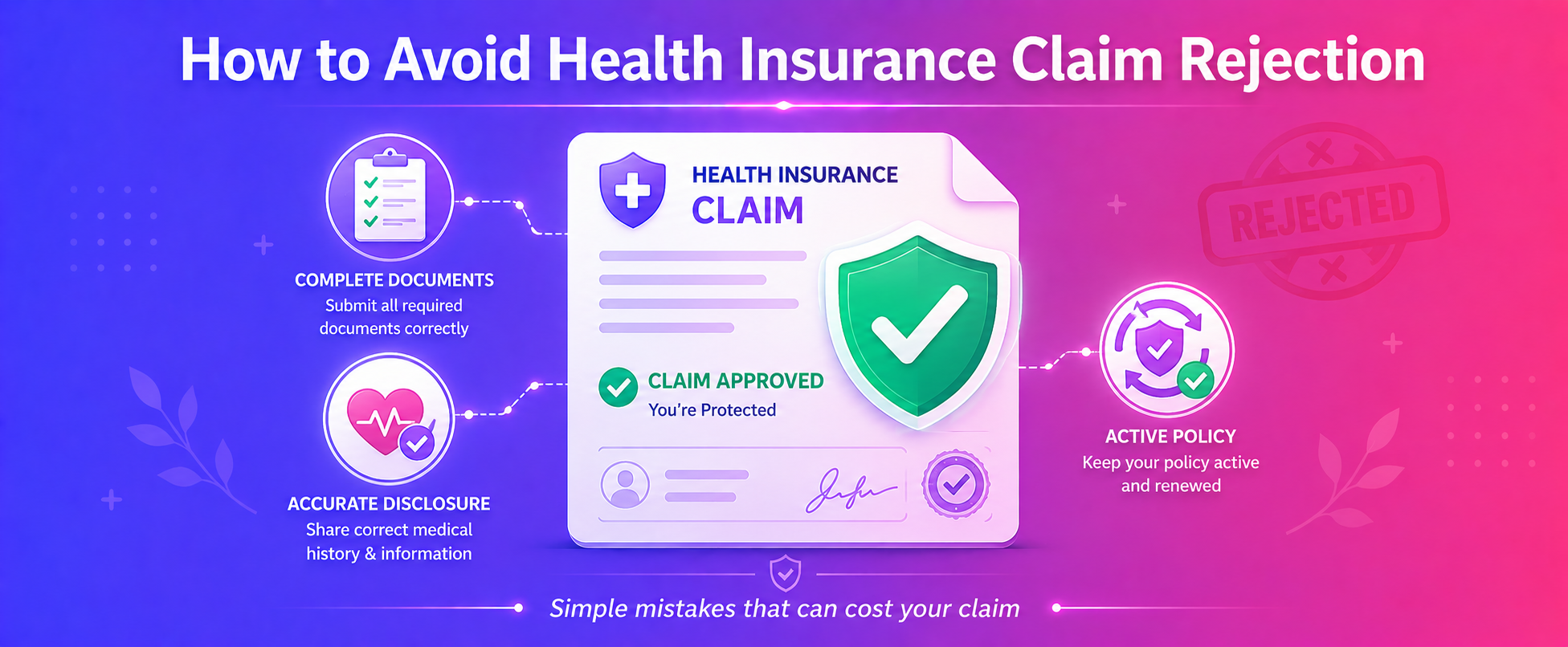
It helps in covering hospitalization, surgeries, medicines and emergency treatments. But many policyholders end up being disappointed when their health insurance claim is denied. Most claim denials are from avoidable errors, missing documents, misinterpretation of the policy, or non-disclosure of medical facts.
A denied claim can put additional financial pressure on an already difficult medical situation. Hence, knowing how to prevent claim rejection is as important as buying the policy itself.
The good news is that most claim rejections can be avoided with proper planning, honest disclosure, timely communication and careful document management. This detailed guide will walk you through the ways to prevent claim rejection in health insurance, the most common reasons for rejection, tips to prevent rejection step by step and smart practices that every policyholder should follow.
What is a health insurance claim rejection in India?
When a health insurance claim is rejected, it means your insurer refuses to pay your medical bills. This differs from them just asking for more details. It is also not the same as getting only a partial payment.
What does health insurance claim rejection mean? Typically, the company will not cover the costs you asked for. Health insurance claim rejection reasons often include errors in your application. Sometimes, you might not follow policy rules. Not sharing all facts can also lead to a rejection.
Why is it important to understand claim rejection? It helps you learn how to avoid claim rejection in health insurance. This knowledge is key for knowing how to avoid health insurance claim rejection in India.
Top reasons for health insurance claim rejection
Many health insurance claims get turned down. Knowing the reasons helps people learn how to avoid claim rejection in health insurance. This guide shares common issues.
Mistake 1: not disclosing pre-existing diseases (PED):
Sharing your full medical history when you buy health insurance matters a lot. Not telling about your current health is a key reason insurers reject claims. They see this as giving wrong details. This directly impacts how to avoid claim rejection in health insurance.
Mistake 2: filing a claim during the waiting period:
Health insurance plans include waiting periods. You cannot make a claim during these specific times. Knowing about these periods is crucial. This knowledge shows you how to avoid claim rejection in health insurance.
Mistake 3: Incomplete or incorrect documentation:
Right papers are key for health insurance claims. Missing bills or partial discharge summaries often lead to claims being denied. This guide shows how to avoid claim rejection in health insurance.
Mistake 4: Treatment not covered under policy exclusions:
Most health insurance plans list treatments they won't cover. These are called policy exclusions. To know how to avoid claim rejection in health insurance, read your policy carefully.
Mistake 5: Delay in claim intimation
Confused between health insurance plans?
Let AI decide for you.
- AI compares 30+ insurers
- No sales pressure
- Result in 60 seconds
- 100% free
No spam. No calls unless you want them.
To help your health insurance claim, always tell your insurer quickly. For emergencies, inform them within one or two days. For planned treatments, let them know before your hospital visit. This shows you how to avoid claim rejection in health insurance.
Mistake 6: Lapsed policy due to non-payment of premium:
Not paying your premium on time, even during the grace period, makes your health policy inactive. This is called a lapsed policy. Any claim for hospital visits during this inactive time will typically be rejected. Knowing this helps you understand how to avoid claim rejection in health insurance.
Mistake 7: Exceeding the sum insured or sub-limits
Your health policy's sum insured is the most money it will pay for claims each year. Sub-limits are fixed caps on specific costs. These often apply to room rent or ICU charges. The insurer only pays up to this limit if you go over it. This helps you understand how to avoid claim rejection in health insurance.
A practical checklist to proactively avoid health insurance claim rejection:
To help ensure your health insurance claims get approved, planning ahead is important. Knowing the right steps can prevent issues later.
This Checklist to avoid health insurance claim rejection offers simple advice. It helps people understand How can I prevent my health insurance claim from being rejected? It also explains What are the steps to avoid claim rejection in India?
Read your policy document thoroughly
Understanding how to avoid claim rejection in health insurance starts with careful review of your policy papers. This important step helps you learn all the plan's rules. It also shows you the specific details of your coverage. This careful review is key to knowing how to avoid claim rejection in health insurance.
Be completely honest in your proposal form
Giving truthful and complete details on your health insurance form is crucial. This step prevents issues with claims later on. To understand how to avoid claim rejection in health insurance, you need to share every fact. Indian insurers, like HDFC ERGO or Star Health, use this data. They check your health risk properly and set policy rules and costs from what you provide.
The IRDAI framework means your policy agreement rests on trust. If you hide key facts, the insurer might reject a claim. So, it is vital to tell everything upfront when you buy a policy. This approach helps you avoid claim rejection in health insurance.
Keep all medical and payment documents organized:
Having clear and complete medical papers is key for any health insurance claim. Indian insurance companies, like Star Health or HDFC ERGO, need certain documents. These papers help them check your treatment and its costs. Organizing them well is a key step. It helps you avoid claim rejection for your health insurance. Sending incomplete papers can delay your claim or make your insurer say 'no.'
You should keep a separate file for each time you stay in the hospital. This simple habit keeps all papers for that visit together. Such an organized system makes it easier for you and the insurance company to send claims. It also helps speed up the checking process. This often means you get your claim paid faster.
Inform your insurer on time
Knowing how to avoid claim rejection in health insurance starts with timely notification. Always tell your insurer about a claim on time. This helps you avoid claim rejection in health insurance. For planned hospital stays, inform them a few days before admission.
Confused between health insurance plans?
Let AI decide for you.
- AI compares 30+ insurers
- No sales pressure
- Result in 60 seconds
- 100% free
No spam. No calls unless you want them.
Prefer treatment at network hospitals
Network hospitals have direct agreements with your insurer. They provide an easy way to get hospital care. This means you avoid paying cash first. It is key for how to avoid claim rejection in health insurance.
Renew your policy before it expires
Renewing your health policy on time prevents gaps in your coverage. This is very important for how to avoid claim rejection in health insurance. Set reminders to renew your plan. You can also use auto-debit for payments.
Key IRDAI rules that protect you
The IRDAI acts as your helper. It keeps Indian policyholders safe. New rules make health insurance claims much simpler to understand. Knowing these rules helps you avoid claim rejection in health insurance. You should know your rights if your insurance claim is rejected. It is also key to understand the IRDAI moratorium period. This time offers good protection. Can an insurer reject a claim after 5 years? IRDAI guidelines give clear answers to these important questions.
The 5-year moratorium period:
IRDAI rules are easy to understand. They provide clear guidance on how to avoid claim rejection in health insurance. You must hold a policy for 5 continuous years. After this period, Indian insurance companies cannot deny your claim. This applies even if you missed sharing some details earlier. They can only reject your claim if there is proven fraud. This rule is a key step in how to avoid claim rejection in health insurance.
Protection against rejection for late intimation:
IRDAI rules can stop your claim from being rejected only for late notice. This holds true if you have good reasons for the delay. Such rules help protect people with insurance plans. However, telling your insurance company fast is still very important. It helps you avoid your health insurance claim being rejected.
Mandatory lifetime renewability
The IRDAI states all health insurance plans must allow lifetime renewal. This is a vital step in how to avoid claim rejection in health insurance later on. Insurers cannot refuse to renew your policy due to your age. Nor can they deny it because of past claims. This rule helps protect policyholders.
What should you do if your health insurance claim gets rejected?
A health insurance claim rejection is not the end. You can challenge the decision. What steps can you take if your health insurance claim is rejected?
Step 1: Understand why your claim was rejected
When your health insurance claim is not approved, first read the rejection letter carefully. The insurance company must write down a clear reason for saying no. This letter is very important. It shows you how to avoid claim rejection in health insurance later. It will tell you the exact rule or a document problem.
Step 2: Correct and resubmit if the rejection was due to a procedural error
If your claim got rejected due to a mistake, you can often fix it. Knowing this helps you stop future health insurance claims from being turned down.
Confused between health insurance plans?
Let AI decide for you.
- AI compares 30+ insurers
- No sales pressure
- Result in 60 seconds
- 100% free
No spam. No calls unless you want them.
Step 3: Approach the insurer's Grievance Redressal Officer (GRO)
If your first appeal fails, move to the next stage. Send an official complaint to the insurer’s Grievance Redressal Officer (GRO). This is a key step in how to avoid claim rejection in health insurance. You can typically find GRO contact information on their website or in your policy papers.
Step 4 - Escalate to the insurance ombudsman
If your insurance company does not fix your problem in 30 days, contact the Insurance Ombudsman. This independent group helps solve disagreements between policyholders and companies. It acts as a fair helper. This is key for how to avoid claim rejection in health insurance.
Conclusion
You can avoid most health insurance claim rejections. Being careful really helps here. Always give honest details about your health when you buy a policy. Also, make sure you understand the rules of your plan. Keeping clear records is useful. Following the correct steps to file a claim will help, too. Knowing your policy well ensures it works for you when needed.
Frequently Asked Questions
Q: Can a claim be rejected after 3 years?
After three continuous years, a claim generally won't be rejected on grounds of non-disclosure or misrepresentation, as per IRDAI guidelines. This period is the moratorium period. However, if fraud is proven (which is quite specific), your insurer can still reject it, even after this time. Beyond
three years, claim processing relies purely on the policy's terms.
Q: Is pancreatitis covered in health insurance?
Pancreatitis is typically covered by Indian health insurance if it requires hospitalisation. If it's a pre-existing condition, you'll face a waiting period, often 2 to 4 years, before claims are accepted (always refer to your policy document). Acute cases needing emergency treatment are usually settled, but chronic pancreatitis might fall under those pre-existing clauses depending on the plan.
Q: Can a claim be partially approved and partially rejected?
A claim can absolutely be partially approved and partially rejected by your health insurer. This usually occurs when certain expenses, like a specific surgery, are covered but others, such as non-medical items or costs beyond your sub-limits (dental treatment isn't typically covered), aren't. Your insurer will detail exactly why any part of the claim wasn't approved.
Q: If my claim is rejected for non-disclosure, is my entire policy cancelled?
A rejected claim for non-disclosure means your insurer won't pay that particular claim. However, if the non-disclosure is deemed material and detected within the first three years, your entire policy typically stands to be cancelled (this can vary by insurer). IRDAI regulations allow insurers to take these actions based on the severity of the information.
Q: Does paying a higher premium reduce the chances of claim rejection?
No, a higher premium doesn't directly reduce claim rejection chances. It typically means you're opting for a bigger sum insured or more full benefits (like added riders). What truly helps is complete disclosure of medical history and knowing your policy's fine print. That's crucial for smooth processing, as per IRDAI guidelines.

Written By
Raj Shankar
Principal Officer and General Manager at CoverTiger
With over 7 years of experience in the insurance and fintech industry, Raj Shankar has helped 10,000+ customers secure their families with the right insurance solutions. He has worked with leading brands such as Policybazaar, INDmoney, and CoverTiger, building strong expertise in health insurance, life insurance, sales leadership, and customer advisory. His mission is to make insurance simpler, more transparent, and accessible for every Indian family.