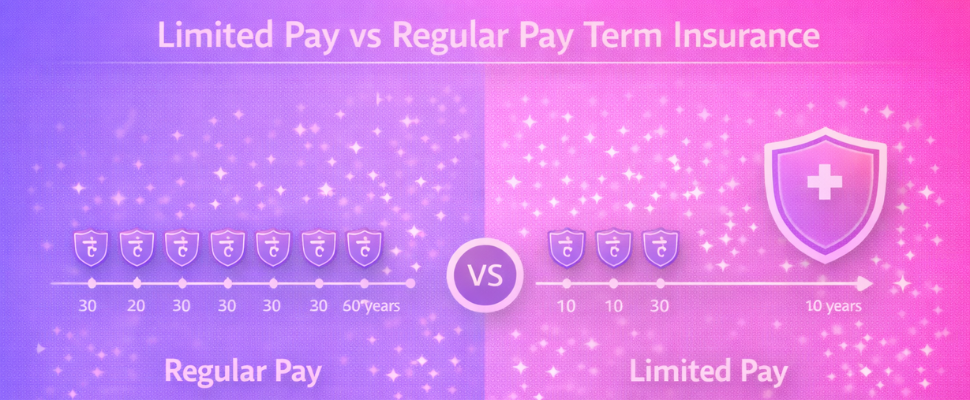
Term insurance helps keep your family's money safe. Choosing how to pay for your policy is an important step. You can pay premiums for a short, set period. Or, you might pay for the entire policy term.
These payment methods are known as limited pay and regular pay. This guide explains the difference between these options for term insurance. It helps you pick the best one for your money needs.
What is regular pay in term insurance?
With regular pay term insurance, you make payments for the whole time your plan is active. For example, if you choose a 30-year plan, you will pay for all 30 years. This is often the simplest way to pay for your term insurance. When you look at regular pay versus limited pay, this choice usually spreads out the cost evenly.
Pros of Regular Pay:
* Lower Yearly Cost:
The money you pay each year is less. This makes it easier to handle your money.
* You can get tax savings in India because of Section 80C for each payment.
Cons of Regular Pay:
* You must make payments over a very long time.
* Risk of Lapse: If you miss payments later on, your insurance might stop.
Who should choose regular pay?
When comparing term insurance limited pay vs regular, regular pay means your insurance cost spreads over the policy's full time. This payment option usually gives you lower, steady costs each year.
- People with a steady, long-term salary often pick this.
- Younger buyers get good value with lower costs for many years.
- People who want smaller, easy-to-manage yearly payments for their budget.
Pros and cons of regular pay in term insurance:
Pros:
Regular pay term insurance often means lower yearly payments. This makes it easier for many people to afford. The cost spreads out equally for the policy's full period. This helps you manage your money each year.
Regular pay term insurance gives you steady, smaller payments. This is different from limited pay plans. These payments give you more money choices.
Not sure how much term cover you need?
Let AI decide for you.
- AI compares 30+ insurers
- No sales pressure
- Result in 60 seconds
- 100% free
No spam. No calls unless you want them.
Cons:
For regular pay, you make premium payments for the entire policy term. This can extend into your retirement years. You might pay even after your steady income stops.
When comparing limited pay term insurance to regular pay, the total money paid is often higher with regular pay. This differs from a limited pay plan.
There is also a risk that your policy might stop working. This happens if your income becomes unsteady later. Such a situation can affect your life cover.
What is limited pay in term insurance?:
Limited pay term insurance means you pay for your policy in a special way. You pay premiums for a shorter payment period. However, your full life cover stays active for the entire policy term. For instance, you could pay premiums for 10 years only. The life insurance cover might then last for 30 years. This payment choice can help you have more money later. It typically removes the need to pay during retirement. This is a main difference in term insurance limited pay vs regular plans.
Who Should Choose Limited Pay?
Limited pay plans often work well for people with good income now. This plan helps you pay your premiums faster. It makes sure your sum assured covers the policy's whole term. This is a main difference between limited pay and regular term insurance.
- People who earn a lot, like business owners or freelancers, find this plan helpful.
- You can finish paying premiums before you retire.
- This plan is for people ready to pay more each year over a short time.
Pros and cons of limited pay
Choosing limited pay for term insurance means you pay premiums quicker. This often brings more financial freedom later. It’s wise to understand term insurance limited pay vs regular options for your money plans.
Pros
- Your premiums end before you retire, easing future costs.
- It provides long-term cover with a shorter payment period.
- Knowing your death benefit is clearer.
Cons
- Yearly payments are typically higher than regular pay plans.
- You need more cash handy during the payment phase.
How limited pay and regular pay term insurance actually differ:
Deciding between limited pay and regular pay term insurance needs some thought. A clear comparison of term insurance options can help you pick the best fit for your money. This section will show the main differences between limited pay and regular pay plans.
Not sure how much term cover you need?
Let AI decide for you.
- AI compares 30+ insurers
- No sales pressure
- Result in 60 seconds
- 100% free
No spam. No calls unless you want them.
Here is a look at these two ways to pay for your policy:
- How long you pay premiums: Limited Pay plans ask for payments over a shorter, fixed period. This might be for 5, 10, or 15 years. You pay premiums for the policy's entire term with a Regular Pay plan.
- Your yearly premium will be higher with Limited Pay plans. Regular Pay plans usually have smaller yearly payments.
- Total money paid: Often, the total money you pay over the policy's life is quite similar for both. For limited pay, you pay more upfront.
- Who it suits best: Limited Pay often works for people with a lot of steady income today. It is also good for those planning an early retirement. Regular Pay is generally better for younger buyers. It also suits anyone needing lower short-term money costs.
- A larger payment is needed right away with Limited Pay. Regular Pay plans spread your money payments out over many years.
Which premium payment option is better for you?
Choosing the best way to pay for your insurance is a personal choice. No single option is perfect when looking at term insurance limited pay vs regular. Your financial goals and current money situation truly decide the right plan.
Think about your income stability. How steady is your money now, and how will it be later? A limited pay plan could work if you expect a high, steady income for some years. This lets you finish payments quicker. However, if your income might change, regular pay usually offers more flexibility.
People just starting their careers often prefer regular pay. This makes the long-term money commitment smaller for each payment. On the other hand, those nearing retirement might find limited pay a smart idea. It helps them finish payments before their income decreases.
Consider your ability to manage bigger payments over a shorter period. This decision impacts your other financial goals. The best way to choose payment option is to ensure it fits well with your full financial plan.
What about single pay term insurance?
Beyond common term insurance limited pay vs regular plans, another choice exists. It is known as single pay term insurance. With this option, you pay the whole policy premium at once. This means you make a lump sum premium as a one-time payment when your policy starts.
This plan often suits people with a good amount of cash on hand. Maybe they got a big bonus, or received an inheritance. Such individuals usually want to avoid any future payments.
How to compare term insurance plans intelligently:
Once you pick between term insurance limited pay vs regular, finding the best plan matters a lot. Do not just check the premium amount. You should compare term insurance plans using a few main points.
Start by looking at the insurer's claim settlement ratio. This number tells you how many claims an Indian company usually pays. Also, see what riders and policy features are offered. Carefully read the policy exclusions.
For a proper insurance comparison, use a smart platform like Cover Tiger. This tool offers recommendations based on solid data. It helps remove sales pressure. You can then confidently select a plan that fits your life.
Conclusion
Choosing between term insurance limited pay vs regular is a personal financial decision. No single option works for everyone.
Regular pay plans typically mean lower starting premiums. You make steady payments over many years. Limited pay, however, lets you finish payments in a fixed term. This gives you freedom from future bills.
Your term insurance choice really depends on your current money situation. It also links to your long-term goals. Weigh these carefully before you decide. Use a trusted comparison tool to help you. Find a policy that fits your payment choice and offers the right coverage.
Not sure how much term cover you need?
Let AI decide for you.
- AI compares 30+ insurers
- No sales pressure
- Result in 60 seconds
- 100% free
No spam. No calls unless you want them.
Frequently Asked Questions
Q: Why do limited pay policies have higher premiums?
Limited pay policies typically have higher premiums because you're condensing all future payments into a much shorter period. An insurer needs to collect the entire sum for, let's say, 25 years of cover over just 5 or 10 years (a common structure). Your policy stays active for the full term, even after premium payments stop, reflecting the time value of money. It's simply paying more now for that long-term benefit.
Q: What is the difference between single pay and limited pay?
Single pay means you pay the entire premium as a one-time lump sum upfront for the whole policy term. With limited pay, you complete all your premium payments within a shorter, fixed period, say 5 or 10 years (this can vary by insurer), but your cover continues for the full duration. It's often preferred by those wanting to finish payments early.
Q: What is an example of a limited premium payment?
A common example involves paying premiums for a term plan for just 10 years. However, your life cover continues for the entire policy term, say, until age 75. You essentially complete all payments early (this applies to many plans from Indian insurers), typically over 5, 7, or 15 years. It's a structured payment approach.
Q: Can I switch from a regular pay to a limited pay plan after the policy starts?
You can't typically switch from regular to limited pay once your policy has started. The payment structure is a basic clause of your original contract (this often varies by insurer). You'd usually need to surrender that policy and buy a brand new one, with fresh underwriting based on your current age.
Q: Are the tax benefits under Section 80C different for limited and regular pay options?
No, for Section 80C purposes, the tax benefits aren't different for limited or regular pay options. Your eligibility for deduction depends purely on the premium amount paid within a financial year, typically up to Rs. 1.5 lakh. Both modes qualify, provided your annual premium doesn't exceed 10% of the sum assured (this applies to most plans).
Q: Is the limited pay option available with all term insurance plans?
Limited pay isn't offered with every term insurance plan. Many Indian insurers provide this option, letting you finish payments over a shorter, fixed term (typically 5 or 10 years). You'll usually find it with plans offering higher sum assured, but do check the specific policy document for confirmation (this can vary by product).
Q: Which premium payment option is generally more cost-effective over the entire policy duration?
Limited pay options are typically more cost-effective over the policy's full duration. You consolidate your premiums into a shorter period, meaning your total outflow is usually less than a regular pay plan. It's a bigger bite each time, but the overall cost is lower (check with your insurer). Ultimately, your cash flow dictates what works best.
Q: What happens if I miss a premium payment for either a limited or regular pay policy?
A missed premium payment initiates a grace period, typically 15 or 30 days depending on your payment mode. Your policy coverage stays active during this time, letting you pay without penalty (check your specific policy terms). If it's not paid, the policy lapses, meaning your cover stops. Reinstatement is usually possible, but it'll involve your insurer's process and possibly new medicals.

Written By
Raj Shankar
Principal Officer and General Manager at CoverTiger
With over 7 years of experience in the insurance and fintech industry, Raj Shankar has helped 10,000+ customers secure their families with the right insurance solutions. He has worked with leading brands such as Policybazaar, INDmoney, and CoverTiger, building strong expertise in health insurance, life insurance, sales leadership, and customer advisory. His mission is to make insurance simpler, more transparent, and accessible for every Indian family.