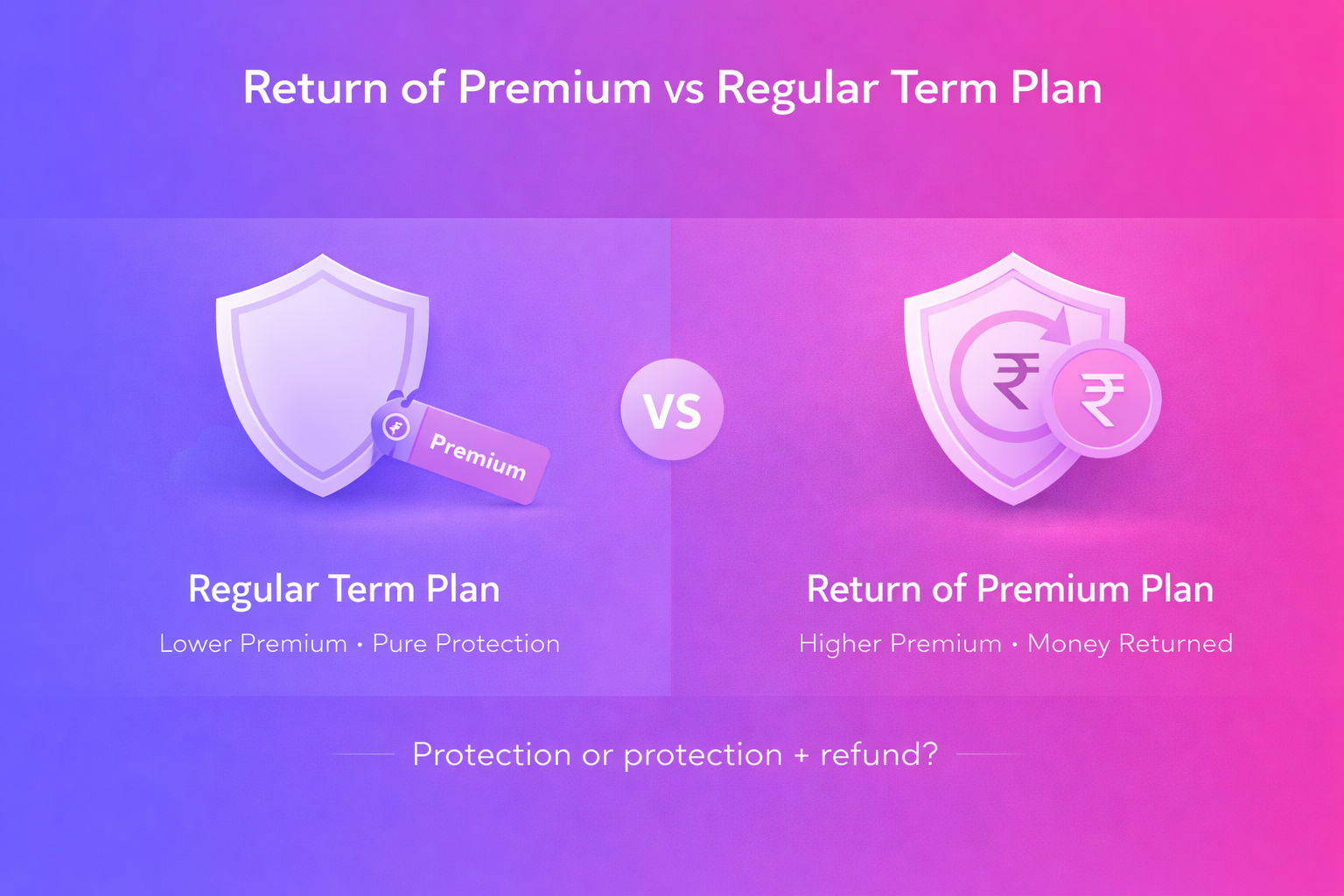
Keeping your family safe financially matters. Term insurance gives important life cover. It protects your loved ones if you pass away. When you buy term life insurance, you find two main choices.
These are the Regular Term Plan and the Return of Premium (ROP) option. A Regular Term Plan typically offers pure protection. This comes at a lower cost. Return of Premium, however, adds a special savings-like benefit.
This guide will compare the return of premium vs regular term plan. We look at their costs and benefits. This helps you choose what fits your needs best.
What is a regular term insurance plan?
A Regular Term Plan offers pure protection for your family. This life insurance policy gives them money if you pass away. If the policyholder dies while the plan is active, the chosen nominee gets
a payment. This payment is known as the sum assured or death benefit.
This plan typically does not pay money back if you outlive the policy term. You will not get your premium payments back. There is no maturity benefit. This is a key difference in the discussion of return of premium vs regular term plan. The main advantage of a Regular Term Plan is that it offers high life cover for affordable premiums. This is often an important factor for many families.
What is a Return of Premium (ROP) term insurance plan?
A Return of Premium (ROP) Term Insurance Plan works like regular term insurance. It gives a death benefit. However, an ROP plan also adds a survival benefit. If you live for the whole policy term, the insurer returns all money paid as premiums. This means you get a full premium refund.
This special feature makes the Return of Premium (ROP) Term Insurance Plan unique. But this added benefit typically means higher premiums. Remember this when you compare return of premium and regular term plan options.
How ROP vs regular term insurance compares side by side:
Picking the right term insurance plan is a big step for your family's financial future. This plan offers a safety net. Many people look at two main choices: the Return of Premium (ROP) Term Plan and the Regular Term Plan. Understanding their key differences helps you make a smart decision. Your best fit depends on your money goals, your budget, and what level of risk you are comfortable with.
Now, we will compare Regular Term and Return of Premium Term Insurance. This comparison shows how each plan works. It explains how they meet different money needs. We will point out the main differences in several areas. These include the cost of premiums and what death benefits are paid. Also, we will look at any maturity benefits.
Tax benefits are also important. These fall under Section 80C and Section 10(10D) of the Income Tax Act, 1961. This detailed look makes the talk about return of premium vs regular term plan clear. Both plans aim to give a set amount of money to your chosen family. Yet, their setups and benefits vary quite a bit. This side-by-side comparison gives you the facts. This way, you can pick the plan that best fits your long-term security needs.
Premium cost:
Regular term plans are much cheaper. For a Return of Premium (ROP) plan, the cost is quite a bit more. It typically costs two or even three times as much as a standard term plan. This extra money you pay helps fund the future refund you get. Consider other ways to use this extra cash.
- Regular term plans mean a low insurance premium.
- ROP plans are more expensive for the refund you receive.
- You could invest the extra ROP premium somewhere else instead.
Not sure how much term cover you need?
Let AI decide for you.
- AI compares 30+ insurers
- No sales pressure
- Result in 60 seconds
- 100% free
No spam. No calls unless you want them.
Best For: People who want the lowest starting cost for their insurance.
Survival and maturity benefits:
The key difference between a return of premium plan and a regular term plan often lies in survival. If you live past the plan's term, a regular term policy usually gives no money back. However, an ROP plan returns all premiums paid if you survive. This amount is typically not taxed.
- A regular term plan offers no survival benefit.
- With an ROP plan, you get your premiums back upon survival.
This plan works well for those wanting their money returned if they outlive the term.
Policy term and coverage
The policy's length matters a lot. This is true when you compare return of premium and regular term plans. Regular term plans often cover many years, sometimes even until age 99. ROP plans typically have shorter top limits for policy length. Make sure the policy's length fits your money needs, like a home loan or your children's schooling.
- Regular term plans generally give longer protection.
- ROP plans come with shorter maximum terms.
- Adjust your chosen term to align with your financial goals.
Best For: People who want their insurance to last as long as their specific long-term debts.
Tax benefits
You can get tax benefits for term insurance. When considering return of premium vs regular term plan, premiums paid for both types are deductible. This comes under Section 80C. The money paid out after someone's death is tax-free by Section 10(10D).
- You can deduct premiums under Section 80C.
- A larger ROP premium generally gives a bigger 80C benefit.
- The death payout is tax-free according to Section 10(10D).
Best For: Individuals seeking tax relief on their premium payments and death payouts.
Flexibility and riders:
Both return of premium and regular term plans let people add riders. These riders give you extra protection. This is more than the basic life insurance payout. Such riders make your policy's cover wider.
Not sure how much term cover you need?
Let AI decide for you.
- AI compares 30+ insurers
- No sales pressure
- Result in 60 seconds
- 100% free
No spam. No calls unless you want them.
You can pick protection based on your needs. For example, a young person might add an accidental death benefit. Someone with a family often chooses a critical illness rider. Always check the features. Also, see if riders are there before you buy. Indian companies like HDFC Life or ICICI Prudential typically offer many options. Regular term plans let you increase cover at big life events in most cases. This means your protection grows with new duties, like marriage or childbirth.
Is a return of premium plan worth it for you?
Deciding between a return of premium plan and a regular term plan is a very personal choice. It truly depends on your financial goals and your comfort with risk. Your budget also plays a big part in this decision. Think about your money management and what you need for the future.
You might prefer a return of premium plan if you want your money back. This plan gives back your premiums when the policy term ends, if you outlive it. It typically offers a sense of financial safety.
However, a regular term plan is often a better fit for a high death benefit at the lowest cost. This option lets you invest the money you save on premiums elsewhere. You could get higher returns from these other investments. Choose your term plan carefully based on these points.
Who should opt for a regular term plan?
A basic term plan gives a large sum of money for a set time. It offers simple life insurance at a low cost. This is important for smart financial planning. Understanding the difference between 'return of premium vs regular term plan' helps.
- People seeking maximum life cover for their lowest payments.
- Investors wanting to put saved premium money into other investments for higher returns.
- Those with significant debts needing good coverage on a tight budget.
- This plan is ideal for: Getting the most life protection while keeping your budget in check.
Who is a good fit for a Return of Premium (ROP) plan?
A Return of Premium plan ensures you get your money back. Your insurance premium comes back if you live longer than the policy term. This plan offers life cover and a way to save money. This is a key difference when you compare a return of premium vs regular term plan.
- Many people dislike losing their premiums if they outlive the plan.
- Some want planned savings, with a promise that their money will return.
- People who avoid risk often prefer a guaranteed sum over market-linked returns.
Good For: Those who want life cover and a promise to get their premiums back.
Compare plans smarter with Cover Tiger AI Agent:
Finding the right term life insurance can be tricky. Many plans offer different features. Extra benefits, called riders, also vary. Even how claims are paid change across insurers. A key decision involves understanding the return of premium vs regular term plan options. This choice often feels hard for many people.
An AI insurance comparison tool simplifies your search. Tools like Cover Tiger show term life options clearly. They provide unbiased recommendations based on your money goals. This helps you compare term insurance well.
You see what each plan offers and its costs. This new method helps you pick the right policy. It uses facts, not just general advice.
Not sure how much term cover you need?
Let AI decide for you.
- AI compares 30+ insurers
- No sales pressure
- Result in 60 seconds
- 100% free
No spam. No calls unless you want them.
Conclusion
Regular term life insurance offers pure financial safety. It keeps your monthly payments, known as premiums, low. Return of Premium (ROP) plans usually give similar coverage. However, they return your premiums when the plan finishes, which typically costs more.
Choosing between a Return of Premium plan and a regular term plan depends on two main things. Consider your budget and how you view money.
We suggest you look closely at both options. Use a good tool to compare the real numbers. This helps you pick the right insurance and make an informed decision for your loved ones.
Frequently Asked Questions
Q: Is it good to buy term insurance with return of premium?
Term insurance with return of premium (ROP) is generally not the most cost-effective choice. It's considerably more expensive than a pure term plan for the same life cover. You'd usually get much higher coverage for your money with a standard term policy (this varies by insurer), freeing up funds to invest elsewhere for potentially better returns.
Q: Is Rop worth it?
ROP isn't typically worth it for most clients. You'll find these plans come with much higher premiums than a standard term plan. The effective return on that extra premium often struggles to beat inflation (something to consider carefully), so your money doesn't grow much. A simple term plan with independent investing of the premium difference usually makes more sense for your long-term goals.
Q: What happens if I stop paying premiums for an ROP plan?
If you stop paying, the ROP policy typically lapses after the grace period, and your life cover stops. You won't get your premiums returned then (that's the key ROP benefit). However, if the policy has acquired a surrender value as per IRDAI rules, you might receive a small amount, but it won't be your full premiums paid.
Q: Is the GST paid on premiums also refunded in an ROP plan?
No, the GST paid on your premiums isn't typically refunded in a Return of Premium (ROP) plan. This tax is on the insurance service itself, separate from the core premium component that actually gets returned. You'll only receive your base premiums back at maturity (check your policy document for specifics), as per IRDAI guidelines.
Q: Is the maturity amount received from an ROP plan taxable?
Maturity from an ROP plan is typically tax-exempt under Section 10(10D) of the Income Tax Act, 1961. However, for policies issued after April 1, 2012, your annual premium shouldn't exceed 10% of the sum assured. This condition is crucial for it to remain tax-free (always confirm with a tax professional for specific advice).

Written By
Raj Shankar
Principal Officer and General Manager at CoverTiger
With over 7 years of experience in the insurance and fintech industry, Raj Shankar has helped 10,000+ customers secure their families with the right insurance solutions. He has worked with leading brands such as Policybazaar, INDmoney, and CoverTiger, building strong expertise in health insurance, life insurance, sales leadership, and customer advisory. His mission is to make insurance simpler, more transparent, and accessible for every Indian family.