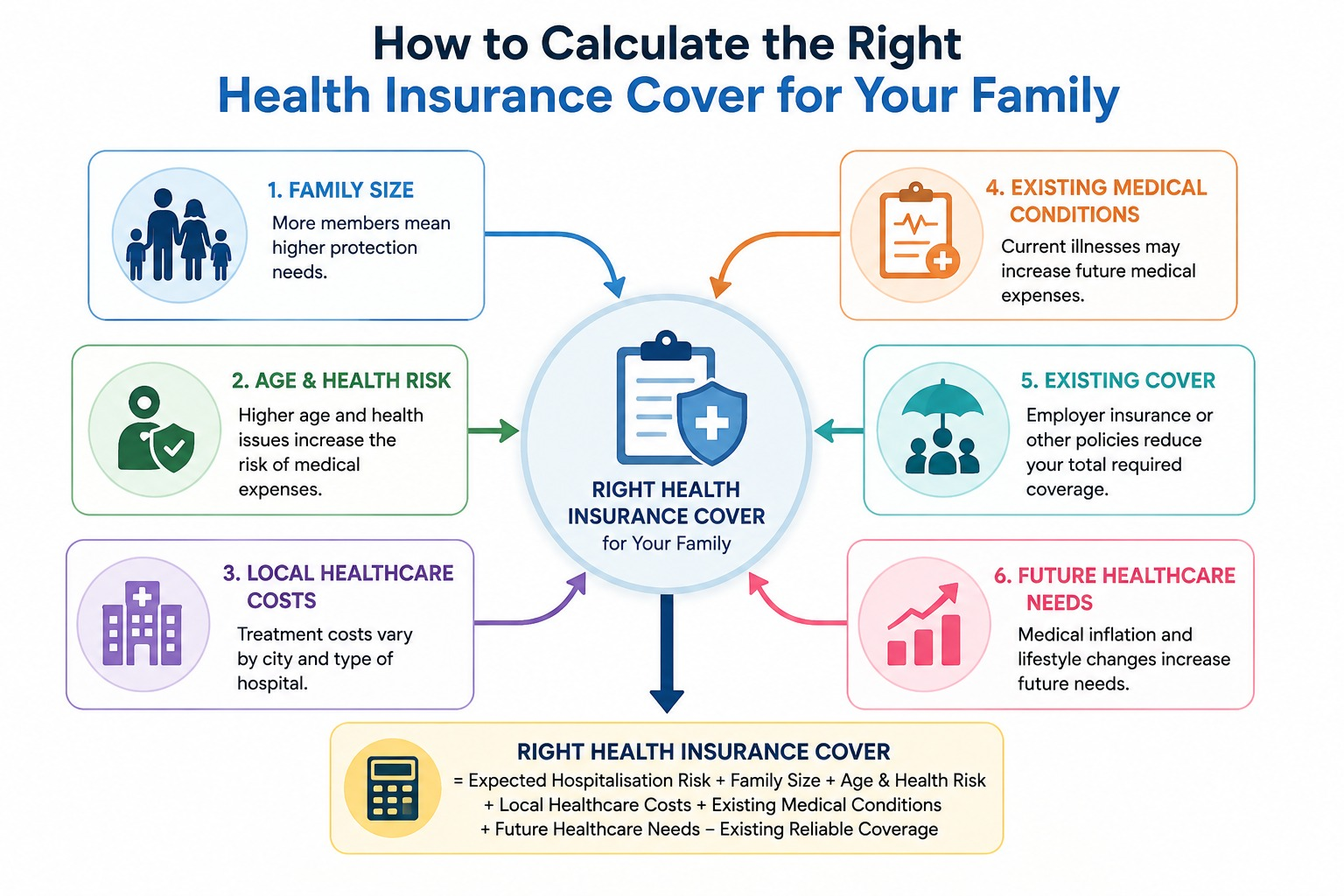
Choosing health insurance for a family is not simply about picking the highest sum insured you can afford. The right health insurance cover depends on who you are covering, their ages, where you live, existing health conditions, healthcare costs, employer coverage, and the healthcare needs you may have in the future.
For an Indian family, the key question is:
How much health insurance cover do we actually need?
There is no single number that works for every family. A young couple with one child may have different needs from a family that also includes ageing parents. The goal is to choose enough coverage to handle a significant hospitalisation without relying heavily on savings.
Quick Answer: How Much Health Insurance Does a Family Need?
A suitable health insurance plan for the family depends on family size, age, health history, location, expected hospitalisation costs, existing coverage, and future healthcare needs.
As a planning exercise, a family might compare ₹5 lakh, ₹10 lakh, ₹15 lakh or ₹20 lakh+ options. These figures are illustrative ranges, not official recommendations from IRDAI or CoverTiger. The right amount depends on your family's specific circumstances and the terms of the policy you choose.
What Does Health Insurance Cover Mean?
Health insurance cover generally refers to the sum insured available under a health insurance policy. It represents the maximum amount payable by the insurer for covered claims during the policy period, subject to the policy's terms, exclusions, limits, deductibles and other conditions.
For example, if a family has a ₹10 lakh family floater policy, the ₹10 lakh is generally a shared sum insured that eligible members can use for covered claims.
A policy with a large sum insured is not automatically a better policy. Room rent limits, co-payment, deductibles, waiting periods, sub-limits, exclusions and network hospital availability can affect how useful the coverage is.
How Do You Calculate the Right Health Insurance Cover for Your Family?
There is no official universal formula for calculating family health insurance coverage. A useful planning framework is:
Required Health Cover = Expected Hospitalisation Risk + Family Size + Age & Health Risk + Local Healthcare Costs + Existing Medical Conditions + Future Healthcare Needs − Existing Reliable Health Coverage
This is a planning framework, not an official insurance formula.
Use the following steps to estimate your family's needs.
1. Count the People You Need to Cover
Start with everyone who needs health insurance.
Consider:
- You
- Your spouse
- Children
- Parents or other dependent family members
A family of two has different coverage needs from a family of four or five.
Also consider whether older family members should be included in the same family floater or evaluated separately.
2. Consider the Age of Each Family Member
Age matters because healthcare requirements can change over time.
A young family may have fewer expected medical expenses today, while older members may require more frequent consultations, procedures or hospitalisation.
When calculating health insurance coverage for a family, look at the age profile of the entire family, not just the age of the person buying the policy.
3. Look at Your City's Healthcare Costs
Hospitalisation costs vary by location, hospital and treatment.
A procedure that costs a certain amount at one hospital may cost considerably more at another. Metro cities can also have different healthcare pricing from smaller cities.
Look at the types of hospitals your family would realistically use and consider the potential cost of a major hospitalisation rather than only routine medical expenses.
4. Consider Existing Health Conditions
Existing medical conditions can affect both healthcare requirements and policy terms.
When buying health insurance, disclose relevant medical information accurately. IRDAI advises policyholders to disclose pre-existing health problems and carefully review waiting periods and exclusions.
Do not assume that buying a higher sum insured automatically means every existing condition is immediately covered.
5. Check Your Existing Employer Health Insurance
Employer health insurance can be useful, but it should not automatically be treated as your family's complete long-term protection.
Check:
- Total sum insured
- Who is covered
- Whether parents are included
- Room-rent restrictions
- Co-payment
- Waiting periods
- Whether the policy continues after leaving the employer
- Whether dependants have separate limits
If employer coverage is limited or dependent on employment, you may want additional personal health insurance.
6. Account for Medical Inflation
Today's hospitalisation cost should not be the only basis for deciding your coverage.
Confused between health insurance plans?
Let AI decide for you.
- AI compares 30+ insurers
- No sales pressure
- Result in 60 seconds
- 100% free
No spam. No calls unless you want them.
Suppose a hospitalisation costs ₹5 lakh today. A similar treatment may cost more in the future because healthcare prices, technology, medicines and hospital charges can change.
Instead of assuming that today's ₹5 lakh will remain sufficient indefinitely, consider whether your coverage can keep pace with increasing healthcare costs.
7. Consider Future Healthcare Needs
Think beyond today's family situation.
Possible changes include:
- Having another child
- Ageing parents
- Increased healthcare requirements with age
- Moving to a more expensive city
- Changing jobs
- Losing employer-sponsored coverage
- Existing conditions requiring more treatment
Your health insurance cover should be reviewed when your family's circumstances change.
A Simple Health Insurance Coverage Calculation
Let's make the framework practical.
Example 1: Young Couple With One Child
Imagine a couple in their 30s living in a metro city with one young child.
For illustration, they may consider:
- Family size: 3
- No major disclosed existing conditions
- Metro-city healthcare costs
- Employer coverage: ₹5 lakh
- Personal family floater: ₹10 lakh
In this example, the ₹10 lakh personal policy is not being described as an official recommendation. The family should compare likely hospitalisation costs, employer coverage limitations and policy terms before deciding whether ₹10 lakh is sufficient.
If the employer policy is unreliable after a job change, the family may also want to reassess whether the personal cover should be higher.
Example 2: Family With Older Parents
Now consider a family with two adults, one child and older parents.
The calculation changes because:
- More people can potentially require treatment.
- Older members may have higher healthcare requirements.
- Existing conditions may affect policy terms.
- A shared floater can be used by one member, reducing what remains for others.
- Separate coverage for parents may need to be considered.
For this type of family, simply adding everyone to one policy without checking the terms may not be the most suitable approach.
The key is to evaluate each person's risk and then decide how the policies should be structured.
How Much Health Insurance Cover Is Enough?
There is no universal “enough” amount. A ₹5 lakh policy may be adequate for one family in a particular situation but insufficient for another family facing higher hospitalisation costs or more complex healthcare needs.
| Cover | Who It May Suit | Main Limitation | When Higher Cover May Make Sense |
|---|---|---|---|
| ₹5 lakh | Smaller families with relatively lower expected costs | Can be consumed quickly by a major hospitalisation | Metro living, larger families, older members or higher healthcare costs |
| ₹10 lakh | Families looking for a larger basic protection level | Still subject to policy limits and exclusions | Higher hospital costs, more family members or limited employer coverage |
| ₹15 lakh | Families wanting more financial headroom | Higher cover does not remove policy restrictions | Families with higher expected healthcare expenses |
| ₹20 lakh+ | Families with larger risk exposure or higher healthcare costs | Premium may be higher and policy terms still matter | Older members, multiple dependants, expensive healthcare locations or stronger long-term protection needs |
These are illustrative comparison levels, not official CoverTiger or IRDAI recommendations. Suitability depends on family profile, location, age, health history, insurer underwriting and policy terms.
Family Floater vs Individual Health Insurance
A family floater health insurance policy generally provides one shared sum insured that can be used by any or all covered family members. IRDAI describes a family floater as a policy where all covered family members share a single sum insured.
An individual policy provides a separate sum insured for each insured person.
| Factor | Family Floater | Individual Health Insurance |
|---|---|---|
| Sum insured | Shared by covered members | Separate for each person |
| Who can use it | Any eligible covered member | The individual insured |
| Family size | Often considered for spouses/children | Can be structured separately |
| Age differences | Larger age differences need careful evaluation | Each person can have their own cover |
| Parents | May require careful assessment | Separate policy can be considered |
| Cost | May be more economical depending on the family and product | Can cost more when multiple policies are purchased |
| When it may suit | Families with compatible risk profiles | Families with significantly different ages or healthcare needs |
Neither option is always better.
For parents or older family members, a separate policy may sometimes be worth evaluating because their healthcare needs and policy pricing can differ significantly from those of younger family members.
How Much Health Insurance Do Parents Need?
Parents often need separate consideration when calculating family health insurance coverage.
Age, existing conditions, expected healthcare usage, waiting periods and policy restrictions can all matter. A shared family floater may also be affected if one older member uses a substantial portion of the common sum insured.
Before including parents in a family policy, compare:
- Their age
- Existing medical conditions
- Current treatment requirements
- Waiting periods
- Co-payment
- Deductibles
- Sub-limits
- Room-rent limits
- Available network hospitals
- Whether separate coverage may be more appropriate
IRDAI states that pre-existing diseases, when covered under a policy, are subject to the waiting period specified in the policy, within the applicable regulatory framework.
This is why parents' coverage should be evaluated on their own needs rather than simply increasing the family floater amount.
Why ₹5 Lakh or ₹10 Lakh May Not Be Enough for Every Family
A fixed sum insured cannot guarantee that every hospitalisation will be fully covered.
A ₹5 lakh policy could be quickly used by a major hospitalisation. Even ₹10 lakh may not be sufficient in every situation, particularly where multiple family members need treatment during the same policy period.
Confused between health insurance plans?
Let AI decide for you.
- AI compares 30+ insurers
- No sales pressure
- Result in 60 seconds
- 100% free
No spam. No calls unless you want them.
The actual amount payable can also be affected by:
- Room-rent limits
- Co-payment
- Deductibles
- Sub-limits
- Exclusions
- Waiting periods
- Non-covered expenses
- Policy-specific conditions
Therefore, calculating the right health insurance coverage amount means looking at both the sum insured and the policy structure.
Health Insurance Features That Matter Beyond Sum Insured
A higher sum insured is useful only when the policy terms support meaningful coverage.
Waiting Period
Some treatments and pre-existing conditions can have waiting periods. IRDAI's current health insurance FAQ states that the maximum waiting period under the applicable framework is 36 months. Always check the actual policy wording for the waiting period applicable to your condition or treatment.
Room Rent Limits
A room-rent limit can affect the amount payable for certain hospitalisation expenses. Check whether the policy has room-category restrictions.
Co-payment
A co-payment means you bear a specified percentage of an admissible claim. IRDAI defines co-payment as a cost-sharing requirement and notes that it does not reduce the sum insured.
Deductibles
A deductible is an amount that must be borne before the insurer becomes liable for applicable benefits under an indemnity policy.
Sub-limits
Some policies may apply limits to particular treatments or expenses. Review these before choosing a policy.
Network Hospitals
Check whether hospitals you would realistically use are included in the insurer's network and understand the cashless hospitalisation process.
Restoration or Recharge Benefit
Some policies may restore or recharge the sum insured after it is used, subject to policy conditions. This can be useful, but the exact restoration rules matter.
No Claim Bonus
A policy may provide a cumulative bonus or increased sum insured for claim-free periods, depending on the product. IRDAI defines cumulative bonus as an increase or addition to the sum insured without an associated increase in premium.
Pre-existing Disease Terms
Always check how the policy defines and handles pre-existing diseases, including waiting periods, exclusions and underwriting requirements.
How to Check Whether Your Current Health Insurance Is Enough
Review your existing policy at least whenever your family circumstances change.
Health Insurance Coverage Checklist
- Count everyone currently dependent on the coverage.
- Check the total sum insured.
- Check whether the sum insured is shared or individual.
- Review the ages of all insured members.
- Review existing medical conditions.
- Compare your cover with current hospitalisation costs.
- Check employer health insurance separately.
- Check room-rent limits.
- Check co-payment and deductibles.
- Review waiting periods.
- Check exclusions and sub-limits.
- Check network hospitals.
- Review restoration and cumulative/no-claim benefits.
- Reassess coverage after major family or job changes.
Common Mistakes When Choosing Health Insurance Cover
1. Choosing a number without considering family size
A ₹5 lakh policy means something different for one person and a family of four.
2. Depending entirely on employer insurance
Employer coverage can change when employment changes. Understand what protection you have outside your workplace.
3. Adding older parents without comparing policy structure
Parents may have different healthcare needs and policy considerations.
4. Focusing only on premium
A low premium does not automatically mean the policy provides the coverage structure your family needs.
5. Ignoring co-payment and deductibles
These can increase your share of a claim.
6. Not checking waiting periods
A policy may not immediately cover every condition or treatment.
7. Assuming a higher sum insured solves every problem
Confused between health insurance plans?
Let AI decide for you.
- AI compares 30+ insurers
- No sales pressure
- Result in 60 seconds
- 100% free
No spam. No calls unless you want them.
Policy limits, exclusions and sub-limits can still affect claims.
8. Never reviewing the policy
Your family's healthcare requirements can change. Your insurance should be reassessed when your circumstances change.
How CoverTiger Helps You Understand Health Insurance
Health insurance can feel complicated because policies use terms such as sum insured, deductible, co-payment, waiting period and sub-limits.
CoverTiger is designed to be your family's AI insurance guardian.
It helps users understand health insurance in simple language, compare relevant options and make more informed decisions without turning the process into a confusing technical exercise.
Meet Ira — CoverTiger's Health Advisor
Ira is CoverTiger's data-trained AI Health Advisor, designed to help users understand health insurance in simpler terms.
Whether you are trying to understand family health insurance coverage, compare policy features or work out what questions to ask before buying, Ira can help you make sense of the information.
The goal is not to promise a guaranteed “best” policy. It is to help you understand your choices so you can make a more informed decision.
Frequently Asked Questions
1. How much health insurance cover does a family of 4 need?
There is no universal amount for a family of four. Start by considering the ages of all four members, location, healthcare costs, existing conditions, employer coverage and expected future needs. Compare options such as ₹10 lakh, ₹15 lakh and ₹20 lakh+ as planning points rather than treating any one amount as a guaranteed recommendation.
2. Is ₹5 lakh health insurance enough for a family?
₹5 lakh may be sufficient for some families but may not provide enough financial headroom for a major hospitalisation or multiple claims. Consider your family size, location, age profile, healthcare costs and policy restrictions before deciding. A higher sum insured may make sense when healthcare costs or family risk are higher.
3. Is ₹10 lakh health insurance enough for a family?
₹10 lakh can provide more coverage than ₹5 lakh, but it is not automatically sufficient for every family. Consider whether the cover is shared, whether older members are included, your city’s healthcare costs, employer coverage and policy limits. The right amount should be based on your family's actual risk profile.
4. How do I calculate the right health insurance cover?
Consider family size, age, health conditions, local hospital costs, future healthcare needs and existing reliable coverage. A useful planning framework is expected hospitalisation risk plus family and health factors, minus reliable existing coverage. This is a planning approach, not an official insurance calculation formula.
5. Should I choose family floater or individual health insurance?
It depends on your family's structure. A family floater provides a shared sum insured, while individual policies provide separate coverage. A floater may work well for families with compatible risk profiles, while separate policies may deserve consideration when members have significantly different ages or healthcare needs.
6. How much health insurance should I have for my parents?
Parents should be evaluated separately based on age, existing conditions, healthcare usage, waiting periods, co-payment, deductibles and other policy terms. Depending on the circumstances, separate health insurance for parents may be worth considering instead of relying entirely on a shared family floater.
7. Does employer health insurance provide enough coverage?
It may or may not. Check the total sum insured, covered dependants, parents' coverage, room-rent limits, co-payment, waiting periods and what happens when you leave the employer. If employer coverage is limited or employment-dependent, personal health insurance can be considered as an additional layer.
8. Should health insurance coverage increase with age?
It is sensible to review coverage as family members age because healthcare requirements and hospitalisation risks can change. You should also review your cover after marriage, having children, adding dependants, moving cities or experiencing significant changes in healthcare needs.
9. What is sum insured in health insurance?
Sum insured is the coverage amount available under the policy for covered claims, subject to its terms and conditions. In a family floater, the amount is generally shared among covered family members. A higher sum insured does not override exclusions, deductibles, co-payments or other policy restrictions.
10. What factors affect health insurance coverage requirements?
Important factors include family size, age, location, healthcare costs, existing conditions, medical history, employer coverage, expected future healthcare needs and policy structure. You should also consider room-rent limits, co-payment, deductibles, sub-limits, waiting periods and network hospitals.
11. Does medical inflation affect health insurance coverage?
Yes. Healthcare costs can increase over time, so today's hospitalisation cost should not be the only basis for choosing coverage. A policy that seems adequate today may provide less financial headroom in the future. Review your sum insured periodically as your family and healthcare costs change.
12. Can I increase my health insurance cover later?
Depending on the insurer and product, policyholders may have options to increase coverage at renewal or through other available products or features. Any increase can be subject to underwriting and applicable policy terms. Check the insurer's current rules before assuming that additional cover will be available on specific terms.
Key Takeaways
- There is no single ideal health insurance cover for every Indian family.
- Calculate coverage based on family size, age, health history, location and healthcare costs.
- Employer insurance should be evaluated separately rather than automatically treated as sufficient.
- Parents may need a different coverage strategy from younger family members.
- ₹5 lakh, ₹10 lakh, ₹15 lakh and ₹20 lakh+ are useful comparison points, not universal recommendations.
- Sum insured is only one part of a policy; waiting periods, co-payment, deductibles, room-rent limits and exclusions also matter.
- Review your health insurance whenever your family, job, location or healthcare needs change.
Final CTA
Not sure how much health insurance your family needs?
Use CoverTiger to understand your family's health insurance needs, explore suitable coverage options and make a more informed decision.

Written By
Raj Shankar
Principal Officer and General Manager at CoverTiger
With over 7 years of experience in the insurance and fintech industry, Raj Shankar has helped 10,000+ customers secure their families with the right insurance solutions. He has worked with leading brands such as Policybazaar, INDmoney, and CoverTiger, building strong expertise in health insurance, life insurance, sales leadership, and customer advisory. His mission is to make insurance simpler, more transparent, and accessible for every Indian family.