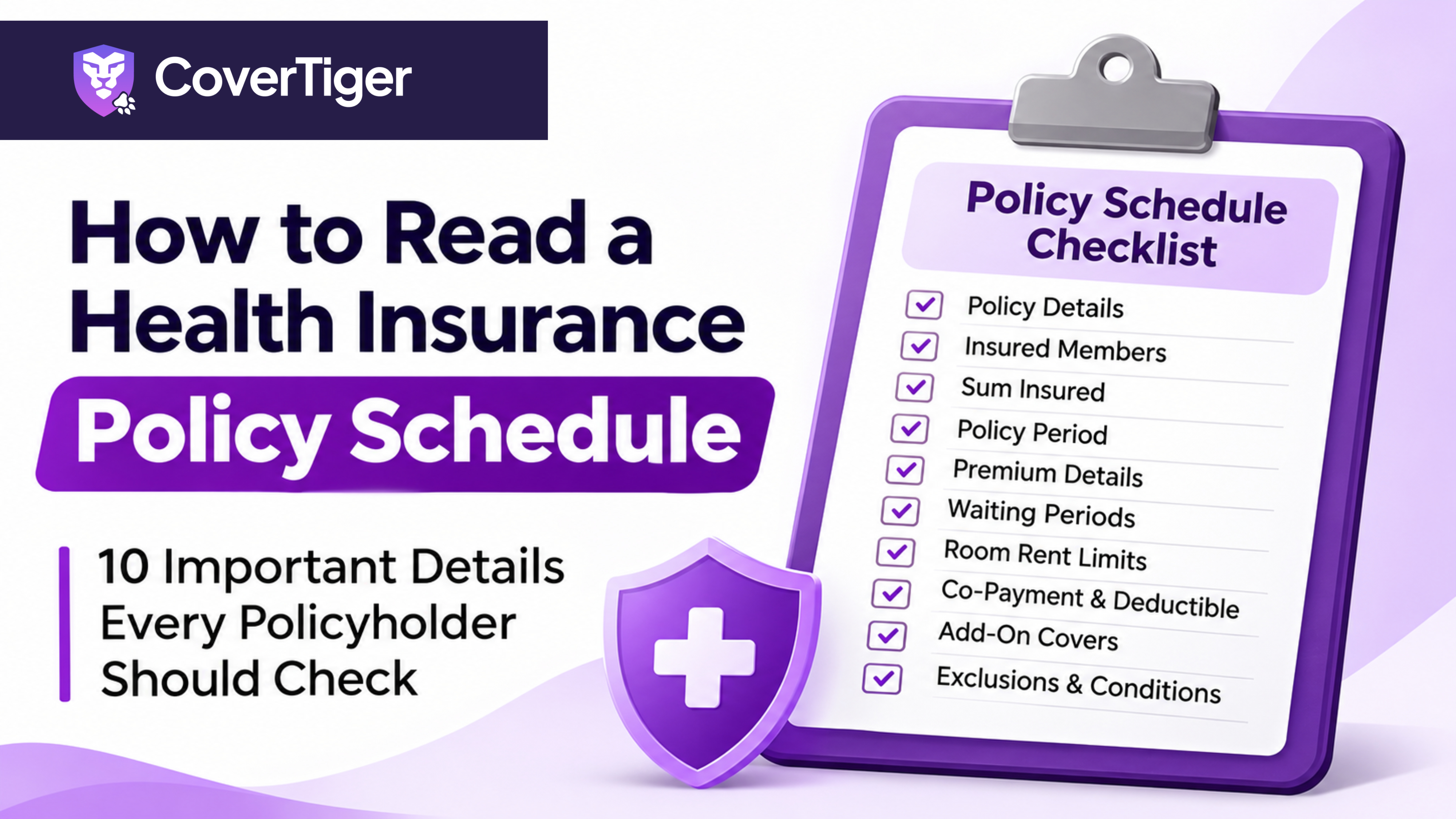
How to Read a Health Insurance Policy Schedule: 10 Important Details Every Policyholder Should Check
Buying health insurance is an important step towards protecting yourself and your family against unexpected medical expenses. However, purchasing a policy is only the beginning. Understanding what your policy actually covers is equally important.
Many policyholders receive their health insurance documents but do not carefully review them. They may know their sum insured and premium but overlook important details such as waiting periods, room rent limits, co-payments, exclusions and policy-specific conditions.
This is where a health insurance policy schedule becomes important.
A policy schedule is an important part of your insurance documentation. It summarises key information about your policy, including the insured members, coverage amount, policy period and applicable details. Understanding it can help you know what to check before making a claim or renewing your policy.
In this guide, we will explain how to read a health insurance policy schedule and highlight 10 important details every policyholder should review.
What Is a Health Insurance Policy Schedule?
A health insurance policy schedule is a document that contains important details specific to your insurance policy.
It generally provides an overview of your coverage, insured persons, policy dates, premium and other applicable information. Think of it as a quick reference for understanding the main details of your health insurance plan.
Depending on the insurer and policy structure, a policy schedule may include:
- Policy number
- Policyholder's name and details
- Names of insured members
- Policy start and end dates
- Sum insured
- Premium details
- Policy type
- Add-on covers, if applicable
- Nominee details, where relevant
- Other policy-specific conditions
It is important to remember that the schedule should be read along with the complete policy wording. The schedule alone may not contain every coverage condition, exclusion or limitation.
Why Is It Important to Read Your Health Insurance Policy Schedule?
Many insurance-related misunderstandings happen because policyholders are unaware of the details mentioned in their documents.
For example, someone may assume that every hospital expense is covered simply because they have a health insurance policy. However, actual coverage depends on the policy's terms, exclusions, limits and applicable conditions.
Reviewing your policy schedule can help you:
- Verify that your personal details are correct.
- Confirm the insured members.
- Check the policy period.
- Understand the available sum insured.
- Identify applicable add-on covers.
- Review important policy conditions.
- Prepare questions before renewal or making a claim.
A careful review can help you understand your insurance protection more clearly. You can also explore CoverTiger's health insurance plans to learn more about health insurance coverage options.
10 Important Details to Check in Your Health Insurance Policy Schedule
1. Policy Number and Policyholder Details
Start by checking your basic policy information.
Your policy schedule generally mentions details such as:
- Policy number
- Policyholder's full name
- Address
- Contact information
- Other identification details, where applicable
Make sure these details match your records. Incorrect personal information can create unnecessary complications during policy servicing or claim-related communication.
If you notice an error, contact your insurer and follow its correction process.
2. Names of Insured Members
If you have purchased an individual or family floater policy, carefully check the names of all insured members.
Verify:
- Full names of insured persons
- Date of birth or age details
- Relationship with the policyholder
- Number of insured members
- Any other member-specific information mentioned
For family floater policies, it is particularly important to confirm that every intended family member is included. Do not assume that a family member is covered unless their inclusion is confirmed in the policy documents.
3. Sum Insured
The sum insured is one of the most important details in a health insurance policy.
It generally represents the maximum coverage amount available under the policy, subject to its terms, conditions and applicable limits.
For example, if your policy has a sum insured of ₹10 lakh, it does not automatically mean that every medical expense up to ₹10 lakh will be payable. The insurer will assess expenses according to the policy's coverage conditions, exclusions, sub-limits and other applicable provisions.
While reviewing this section, check:
- Total sum insured
- Whether it is individual or family floater coverage
- Any additional coverage benefits
- Restoration or recharge benefits, if included
- Any applicable limits
Confused between health insurance plans?
Let AI decide for you.
- AI compares 30+ insurers
- No sales pressure
- Result in 60 seconds
- 100% free
No spam. No calls unless you want them.
Understanding your sum insured helps you evaluate the extent of your financial protection.
4. Policy Start Date and Expiry Date
Your policy schedule should mention the period for which your insurance coverage is applicable.
Check both:
- Policy commencement date
- Policy expiry date
These dates are important because they help you understand the coverage period and renewal timeline.
Do not wait until the last moment to review your renewal. Check the renewal instructions provided by your insurer and ensure that you understand the conditions applicable to continued coverage.
5. Premium and Payment Details
Your policy schedule or related payment documents may mention the premium payable for your insurance.
Check:
- Total premium amount
- Applicable taxes
- Payment frequency
- Payment status
- Any instalment-related information, if applicable
Also verify that the amount paid matches the payment confirmation or receipt issued by the insurer. Keeping your premium payment records organised can help you avoid confusion during policy servicing.
6. Waiting Periods
Waiting periods are important conditions that policyholders should understand before relying on their health insurance coverage.
A waiting period is the specified duration during which certain conditions or treatments may not be covered, as defined by the policy.
Depending on the policy, waiting periods may apply to:
- Initial coverage
- Pre-existing diseases
- Specific illnesses or procedures
- Maternity-related benefits, where covered
You can learn more about pre-existing diseases in health insurance and how they may affect coverage.
The applicable waiting periods may be mentioned in the schedule, policy wording or related endorsements. Do not rely only on a general summary. Check the exact waiting period and conditions mentioned in your insurer's documents.
7. Room Rent Limits and Other Sub-Limits
Some health insurance policies may have specific limits on particular hospital expenses.
These may include:
- Room rent limits
- ICU limits
- Procedure-specific limits
- Disease-specific sub-limits
- Other treatment-related restrictions
For example, a policy may specify a maximum eligible room category or a particular monetary limit for certain expenses. These conditions can affect the amount payable by the insurer.
Review the schedule and complete policy wording to understand whether any such limits apply to your coverage.
8. Co-Payment and Deductible Conditions
Co-payment and deductible conditions can influence how much you may need to pay yourself when making a claim.
Co-payment: A specified percentage of an admissible claim that the policyholder is required to bear, as per the policy terms.
Deductible: A specified amount that must be paid by the policyholder before the insurer's payment obligation applies, according to the policy conditions.
For example, if a policy has a 10% co-payment condition on an admissible claim of ₹1 lakh, the policyholder's share would be ₹10,000, subject to the exact policy terms.
For a clearer explanation, read our guide on co-pays, deductibles and coinsurance in health insurance.
Always check whether these conditions apply to your policy and whether they are linked to particular members, treatments or circumstances.
9. Add-On Covers and Additional Benefits
Some health insurance plans offer optional add-ons or additional benefits.
Depending on the policy, these may include:
- Critical illness benefits
- Personal accident-related benefits
- Maternity benefits
- Hospital cash benefits
- Other optional covers
Confused between health insurance plans?
Let AI decide for you.
- AI compares 30+ insurers
- No sales pressure
- Result in 60 seconds
- 100% free
No spam. No calls unless you want them.
Do not assume that an add-on is included simply because it was discussed during the purchase process. Check whether it is actually mentioned in your policy schedule or relevant endorsement.
Also review its coverage amount, eligibility conditions, exclusions and limitations.
10. Exclusions, Endorsements and Special Conditions
This is one of the most important sections to review.
A policy may contain exclusions and special conditions that determine when coverage is not available or is restricted.
Check for:
- Permanent exclusions
- Specific disease-related conditions
- Special waiting periods
- Policy endorsements
- Member-specific restrictions
- Other special terms
You should also understand permanent exclusions in health insurance to know which conditions or expenses may not be covered under a policy.
An endorsement is a document or amendment that records an approved change to the insurance policy. For example, a change in personal details, addition of an insured member or another policy modification may be documented through an endorsement, depending on the insurer's process.
Always read these conditions carefully and keep updated policy documents for reference.
Policy Schedule vs Complete Policy Wording: What Is the Difference?
Although both documents are important, they serve different purposes.
----------------------------------------------------------------------- Policy Schedule Policy Wording ----------------------------------- ----------------------------------- Summarises key policy-specific Explains detailed terms and information conditions
Mentions insured members Explains member eligibility and
coverage conditionsShows the sum insured Explains how coverage and limits
workMentions policy dates Explains renewal and continuity
provisionsMay list applicable add-ons Explains add-on benefits and
exclusionsMay show special conditions Provides detailed policy exclusions
and limitationsRemember: The policy schedule provides an overview, while the complete policy wording explains the detailed rules governing your coverage. You should review both documents.
Common Mistakes to Avoid While Reading a Health Insurance Policy Schedule
Even after receiving their policy documents, many people make avoidable mistakes.
Here are some common ones:
1. Checking only the sum insured: Coverage also depends on exclusions, limits and policy conditions.
2. Ignoring insured member details: An error or missing member can create confusion about who is covered.
3. Overlooking waiting periods: Certain conditions may have specific waiting periods.
4. Assuming all hospital expenses are covered: Eligible expenses depend on the policy wording.
5. Ignoring co-payment conditions: These can affect your out-of-pocket expenses.
6. Not checking endorsements: An approved policy change may be recorded separately.
7. Reading only the schedule: Important details may be explained in the complete policy wording.
Taking a few minutes to review these details can help you understand your coverage more responsibly.
How Ira, CoverTiger's AI Health Insurance Advisor, Can Help You Understand Insurance Better
Insurance documents can sometimes feel complicated, especially when they contain technical terms and multiple conditions.
This is where an AI-powered guidance experience can make insurance information more approachable.
Ira is CoverTiger's AI Health Insurance Advisor, designed to help consumers explore health insurance questions and understand important insurance concepts.
When reviewing a policy, consumers may have questions such as:
- What does sum insured mean?
- How do waiting periods work?
- What is the difference between co-payment and deductible?
- What are room rent restrictions?
- What should I check in my policy before renewal?
- What do exclusions mean?
Confused between health insurance plans?
Let AI decide for you.
- AI compares 30+ insurers
- No sales pressure
- Result in 60 seconds
- 100% free
No spam. No calls unless you want them.
Ira is positioned around making health insurance conversations easier to understand.
Instead of leaving consumers confused by unfamiliar terminology, CoverTiger aims to make insurance guidance more accessible through its AI-led approach.
Consumers should still verify policy-specific information against the official policy documents and confirm important coverage details with the insurer.
When Should You Review Your Health Insurance Policy Schedule?
Reading your policy schedule should not be a one-time activity.
It is useful to review it during important insurance-related events, such as:
- Immediately after purchasing a new policy
- After receiving a policy renewal document
- When adding or removing an insured member
- After an approved policy modification
- Before planning a major medical procedure
- When preparing to make a claim
- When reviewing your overall family coverage
Keeping your latest policy schedule and complete policy wording accessible can make future reference easier.
Conclusion: Understand Your Policy Before You Need It
A health insurance policy is more than a premium payment and a sum insured amount. Its actual value depends on understanding the coverage, exclusions, waiting periods, limits and conditions that apply.
Your health insurance policy schedule provides an important starting point for reviewing these details.
By checking the 10 points discussed in this guide, you can become more aware of your coverage and identify questions that may need clarification from your insurer.
With CoverTiger's AI-led guidance approach and Ira as its AI Health Insurance Advisor, consumers can explore insurance concepts in a more approachable way.
CoverTiger --- Your Family's AI Insurance Guardian.
Explore CoverTiger's health insurance guidance and plans.
Frequently Asked Questions
1. What is a health insurance policy schedule?
A health insurance policy schedule is a document that summarises important details of your insurance policy, including the policyholder, insured members, policy period, sum insured and other applicable information.
2. Where can I find my health insurance policy schedule?
You can generally find your policy schedule in the policy documents shared by your insurer through email, its customer portal or its official mobile application. You can also contact the insurer if you need another copy.
3. Is a policy schedule the same as a health insurance policy document?
No. The policy schedule is generally a summary of policy-specific details. The complete policy document includes the detailed terms, conditions, exclusions and coverage provisions.
4. What is the most important detail to check in a policy schedule?
There is no single detail that matters in every situation. However, insured member details, sum insured, policy period, applicable limits and special conditions are important starting points.
5. Does the policy schedule mention waiting periods?
Some policy schedules may mention applicable waiting periods or related conditions. However, the complete policy wording should also be checked to understand the exact duration and applicability.
6. What should I do if my policy schedule contains incorrect information?
Contact your insurance company or authorised servicing channel and request a correction through its official process. Keep the updated document once the correction is approved.
7. Can I understand my health insurance policy using an AI advisor?
An AI health insurance advisor can help explain common insurance terms and guide you through questions to consider. However, policy-specific coverage and claim decisions must be verified using the insurer's official documents and confirmation.
8. Why should I review my policy schedule before renewal?
Reviewing your policy schedule before renewal helps you check insured members, coverage amounts, policy details and applicable conditions. It also gives you an opportunity to raise questions with your insurer before continuing coverage.
Disclaimer: This article is for general informational and educational purposes only. It does not constitute financial, medical or insurance advice. Policy coverage, eligibility, waiting periods, exclusions and claims are subject to the insurer's official policy wording, schedule and applicable terms and conditions.

Written By
Raj Shankar
Principal Officer and General Manager at CoverTiger
With over 7 years of experience in the insurance and fintech industry, Raj Shankar has helped 10,000+ customers secure their families with the right insurance solutions. He has worked with leading brands such as Policybazaar, INDmoney, and CoverTiger, building strong expertise in health insurance, life insurance, sales leadership, and customer advisory. His mission is to make insurance simpler, more transparent, and accessible for every Indian family.