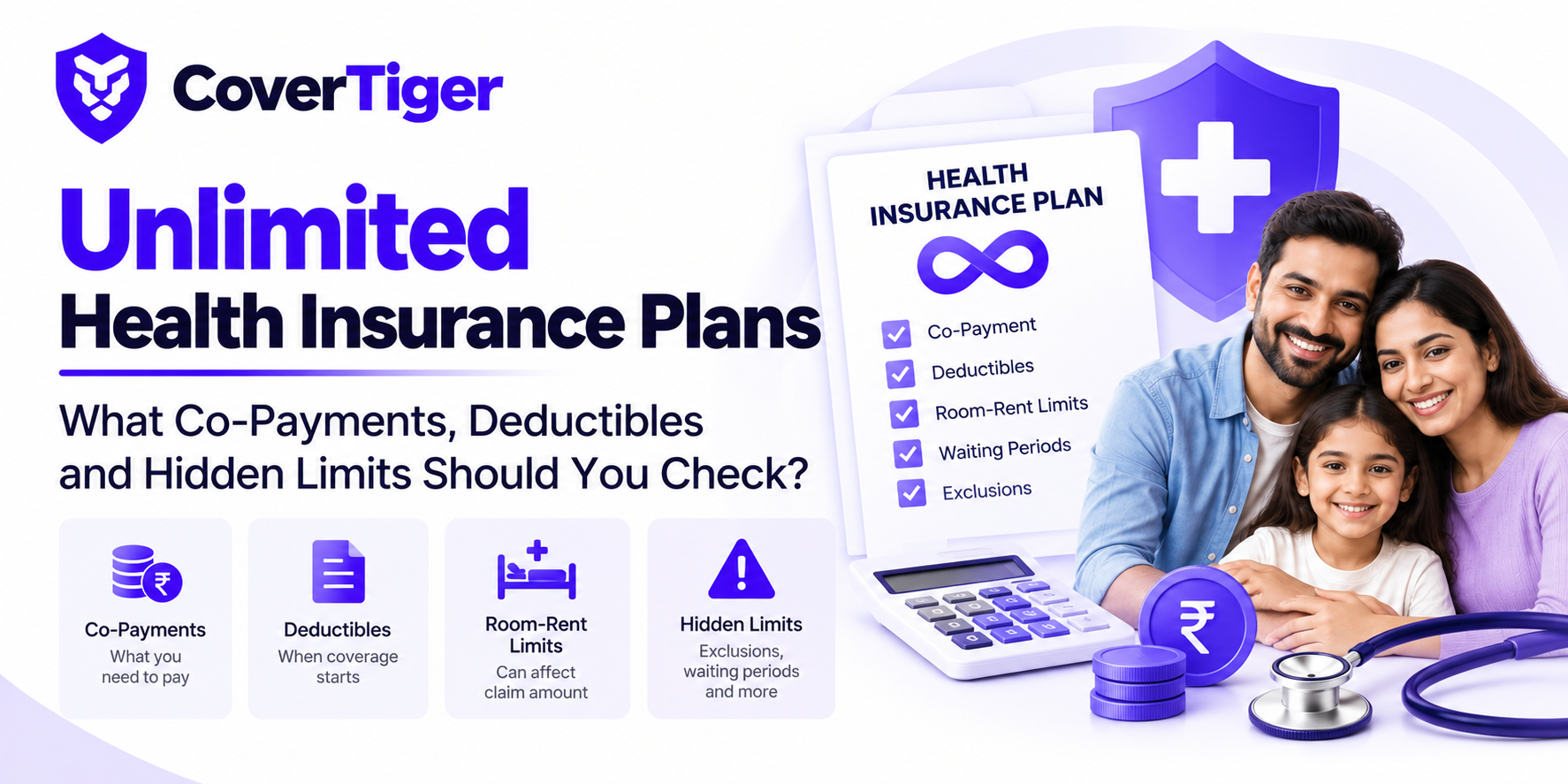
Unlimited Health Insurance Plans: Why Co-Payments, Deductibles and Hidden Limits Matter
Health insurance plans offering unlimited coverage can appear attractive, particularly for people concerned about rising hospital bills and expensive medical treatments. However, the word “unlimited” does not necessarily mean that every hospital expense will be paid by the insurer without restrictions.
A report published by The Financial Express on October 24, 2026, highlights an important consideration for health insurance buyers: unlimited coverage may still come with co-payments, deductibles, room-rent restrictions, waiting periods and exclusions.
These conditions can affect how much an insurer pays and how much the policyholder must pay from their own pocket.
For consumers comparing health insurance plans, the key is to understand what unlimited coverage actually means under a specific policy and whether its benefits justify the premium.
Source: The Financial Express — Look out for co-pay and deductibles in unlimited health plans
What Does Unlimited Health Insurance Coverage Mean?
Unlimited health insurance generally refers to a policy or benefit that removes or substantially changes a conventional fixed monetary limit for eligible hospitalisation expenses. However, the precise meaning depends on the insurer, product and policy wording.
The term may refer to different types of benefits.
1. Unlimited Sum Insured
Some plans offer an unlimited sum insured option under which eligible expenses are not restricted by a conventional fixed annual sum insured. Other policy terms and exclusions may still apply.
2. Unlimited Claim Benefit
Some policies or optional benefits may provide an unlimited amount for a specified number of claims or a particular hospitalisation. The benefit may be subject to conditions on how claims are counted and when the feature can be used.
3. Unlimited Restoration Benefit
Restoration benefits replenish some or all of the sum insured after it has been used, subject to the policy conditions.
However, unlimited restoration is not the same as an unlimited individual claim. A policy with a fixed base sum insured may still cap an individual claim even if the coverage can be restored for subsequent claims.
Before purchasing a plan, confirm which type of unlimited benefit is offered and the conditions under which it applies.
Why “Unlimited” Does Not Always Mean Zero Out-of-Pocket Expenses
Even when a policy offers a high or unlimited coverage benefit, the insurer's payment remains subject to the policy wording.
The policyholder may still have to pay certain expenses because of co-payments, deductibles, room-rent limits, exclusions or other restrictions.
For example, a plan may offer unlimited coverage for eligible hospitalisation expenses but require the policyholder to contribute a specified percentage of the admissible claim.
Similarly, some expenses may not be covered at all, regardless of the overall sum insured.
This is why comparing only the headline coverage amount can give an incomplete picture of a health insurance policy.
5 Important Health Insurance Conditions to Check
1. Co-Payment: What Percentage Must You Pay?
Confused between health insurance plans?
Let AI decide for you.
- AI compares 30+ insurers
- No sales pressure
- Result in 60 seconds
- 100% free
No spam. No calls unless you want them.
A co-payment, commonly called a co-pay, is the portion of an admissible claim that the policyholder must bear under the policy terms.
Suppose a policy has a 20% co-payment and the insurer determines that ₹5 lakh of a hospital bill is admissible.
| Particulars | Amount |
|---|---|
| Admissible claim | ₹5,00,000 |
| Policyholder's 20% share | ₹1,00,000 |
| Insurer's 80% share | ₹4,00,000 |
This is a simplified illustration. The actual amount payable depends on the policy wording, claim assessment and any other applicable limits or deductions.
A co-payment can substantially increase the policyholder's out-of-pocket expenses, especially for large hospital bills.
When comparing plans, check whether a co-payment applies to every claim, specific treatments, certain age groups or particular policy variants.
2. Deductibles: When Does the Insurer Start Paying?
A deductible is an amount that must be paid before the insurer's liability begins under the relevant policy terms.
For example, consider a policy with a ₹2 lakh deductible and a hospital bill of ₹7 lakh.
If the entire ₹7 lakh is otherwise eligible and the deductible applies to that claim, the insurer's payment would generally be calculated after accounting for the deductible. Other policy conditions may affect the final amount.
Deductibles are particularly important when comparing base health insurance policies with top-up or super top-up plans.
Before buying, understand whether the deductible applies per claim, per policy year or under another defined arrangement.
You can also explore top-up health insurance plans to understand additional coverage options and compare their deductible conditions.
3. Room-Rent Limits: Can Your Hospital Room Affect the Claim?
Some health insurance policies specify the room category or room-rent limit available to the insured person.
If a policyholder chooses a room above the permitted category, the policy may apply proportionate deductions to certain associated hospitalisation expenses, depending on its terms.
For example, a policy may restrict the eligible room category even though it advertises a high sum insured.
Before selecting a plan, review:
- Whether there is a room-rent cap.
- Whether ICU charges have separate conditions.
- Whether choosing a higher room category can affect other admissible expenses.
- Whether the policy offers broader room eligibility.
The important point is to understand the actual room eligibility rules rather than assuming that unlimited coverage automatically removes them.
4. Waiting Periods and Pre-Existing Disease Conditions
Health insurance policies may impose waiting periods for specified conditions, treatments or pre-existing diseases.
Unlimited coverage does not automatically remove these waiting periods.
For example, a policy could offer a high coverage limit while still applying a waiting period to a particular condition. If a claim arises during that period, the insurer will assess it according to the applicable policy terms.
Confused between health insurance plans?
Let AI decide for you.
- AI compares 30+ insurers
- No sales pressure
- Result in 60 seconds
- 100% free
No spam. No calls unless you want them.
Before purchasing a policy, check the waiting periods, medical-history disclosure requirements and any exclusions that apply to your circumstances.
Read CoverTiger's guide to pre-existing disease coverage and waiting periods in health insurance for additional information.
5. Exclusions, Sub-Limits and Non-Payable Expenses
A policy's overall coverage limit does not mean every medical expense is automatically payable.
Some policies have specific limits for certain treatments, services or expenses. Others exclude particular treatments or expenses under their terms.
Review the following carefully:
- Disease-specific or treatment-specific sub-limits.
- Excluded treatments and conditions.
- Non-payable hospital expenses.
- Consumables and other charges, where applicable.
- Pre- and post-hospitalisation benefits.
- Optional benefits and their individual limits.
The policy wording and customer information sheet are important sources for understanding these conditions.
Unlimited Health Insurance vs. a Regular Health Insurance Plan
An unlimited plan is not automatically better than a regular plan. The right option depends on your coverage requirements, budget and the actual terms of the products available.
| Factor | Unlimited health insurance | Regular health insurance |
|---|---|---|
| Coverage limit | May offer an unlimited sum insured or a specified unlimited claim benefit | Generally offers a defined sum insured |
| Individual claim limits | Depend on the type of unlimited benefit and policy conditions | Generally subject to the available sum insured and policy terms |
| Restoration | Depends on the product and its benefits | May be available as a built-in benefit or add-on |
| Out-of-pocket expenses | Co-payments, exclusions and other restrictions may still apply | Co-payments, exclusions and other restrictions may also apply |
| Premium | Depends on the insurer, product and applicant | Depends on the insurer, product and applicant |
| Best comparison approach | Review the exact unlimited benefit and its conditions | Compare sum insured, restoration, limits and exclusions |
A regular policy with an appropriate sum insured and useful restoration benefits may be sufficient for some buyers. Others may prefer an unlimited coverage option because of their financial circumstances or concerns about unusually expensive treatment.
The decision should be based on the complete policy rather than its marketing label.
Is Unlimited Health Insurance Worth the Higher Premium?
The answer depends on the coverage offered, the premium difference and your financial priorities.
Before choosing an unlimited plan, ask yourself:
- Do I need protection beyond a conventional fixed sum insured?
- Does the unlimited feature apply to every eligible claim or only specific claims?
- Are co-payments or deductibles required?
- Are there room-rent restrictions or treatment-specific limits?
- How does the premium compare with a regular plan offering restoration benefits?
- Can I afford the premium at renewal as I get older?
It may be useful to compare a higher-cover base policy with a super top-up policy as well. However, a super top-up has its own deductible and claim conditions, so it should not be assumed to be equivalent to unlimited coverage.
You can use CoverTiger's health insurance comparison resource to help organise your comparison of available policy features.
How an AI Health Insurance Advisor Can Help
Comparing unlimited health insurance plans can involve several policy conditions, making it difficult to evaluate products based only on their advertised benefits.
An AI Health Insurance Advisor Online can help users organise their requirements and understand the differences between policy features.
For example, an AI-assisted comparison may help you prepare a checklist covering:
- Sum insured and unlimited claim conditions.
- Co-payment and deductible clauses.
- Room-rent eligibility and sub-limits.
- Waiting periods and exclusions.
- Restoration benefits.
- Premiums and renewal considerations.
Confused between health insurance plans?
Let AI decide for you.
- AI compares 30+ insurers
- No sales pressure
- Result in 60 seconds
- 100% free
No spam. No calls unless you want them.
CoverTiger's Ira — Health Advisor can be positioned as a resource for exploring health insurance options and understanding the factors worth comparing.
AI assistance should support research, not replace official policy documents or an insurer's clarification. AI-generated explanations may omit conditions or misinterpret policy wording, so verify important details before buying.
Checklist: What to Read Before Buying an Unlimited Health Plan
Before purchasing a policy, review these points:
- Understand exactly what “unlimited” means for the selected plan.
- Check whether the benefit applies to every claim or a limited number of claims.
- Confirm the co-payment percentage, if any.
- Understand how the deductible is applied.
- Review room-rent eligibility and ICU conditions.
- Check waiting periods and pre-existing disease terms.
- Read exclusions and treatment-specific sub-limits.
- Confirm the hospital network and cashless process.
- Compare the premium with other suitable plans.
- Read the policy wording and customer information sheet before purchasing.
This checklist can help you compare products more consistently and identify questions that need clarification.
Frequently Asked Questions
Does unlimited health insurance mean all hospital expenses are covered?
No. Unlimited coverage does not automatically remove exclusions, co-payments, deductibles, waiting periods or other restrictions. Only expenses payable under the policy terms are eligible for payment.
Can an unlimited health insurance plan still have a co-payment?
Yes. Depending on the product, a co-payment may still apply. Check the policy wording to understand how the policyholder's share is calculated.
What is the difference between unlimited sum insured and unlimited restoration?
Unlimited sum insured refers to a coverage structure that removes a conventional fixed monetary cap for eligible expenses, subject to policy conditions. Restoration replenishes some or all of a defined sum insured after it has been used. Restoration does not necessarily increase the maximum payable for an individual claim.
Are unlimited health insurance plans better than regular plans?
Not for everyone. Compare the actual coverage, claim conditions, exclusions, premium and restoration benefits before deciding which option suits your needs.
Can a deductible apply to an unlimited health insurance plan?
A deductible may apply depending on the product and benefit selected. Review the policy terms to understand when the deductible applies and how it affects claim payment.
How can I compare unlimited health insurance plans online?
Compare the precise unlimited benefit, co-payment, deductible, room-rent conditions, waiting periods, exclusions, hospital network and premium. Verify the details using each insurer's official policy documents.
Final Takeaway
Unlimited health insurance can provide valuable protection against certain high-cost medical expenses, but the word “unlimited” should never be the only reason to buy a policy.
Co-payments, deductibles, room-rent restrictions, waiting periods, exclusions and other conditions can still influence the amount an insurer pays.
Before choosing a plan, review the policy wording, compare the complete coverage structure and make sure the premium fits your budget. A clear understanding of the policy is more useful than relying on the headline coverage amount alone.
Explore health insurance plans on CoverTiger and compare the available features before making your decision.

Written By
Raj Shankar
Principal Officer and General Manager at CoverTiger
With over 7 years of experience in the insurance and fintech industry, Raj Shankar has helped 10,000+ customers secure their families with the right insurance solutions. He has worked with leading brands such as Policybazaar, INDmoney, and CoverTiger, building strong expertise in health insurance, life insurance, sales leadership, and customer advisory. His mission is to make insurance simpler, more transparent, and accessible for every Indian family.